



The OCC’s final GENIUS act rule is here and the regulator is telling community banks to get a piece of the pie.
More fintech platforms applied for national bank charters to bring banking services in-house, and to bypass intermediaries.
If you work in anything related to the financial industry, it feels like everyone was at the Money20/20 conference in Las Vegas last week talking about agentic commerce. Both the good and the bad.
(We also published a deep dive looking at check fraud. Make sure to check that one out!)
Here’s the Rundown:
The Office of the Comptroller of the Currency issued its final rule implementing the GENIUS Act for payment stablecoins.
Ramp and Sezzle applied for national bank charters to bypass bank intermediaries.
Prosecutors in Los Angeles charged 15 defendants in an alleged $2 billion healthcare and hospice fraud sweep.
A few banks and payment networks rolled out consumer tokenized deposits, commercial stablecoin rails, and retail pilots.
The Central Bank of Ireland fined Coinbase Ireland €3.25 for safeguarding failures and client fund protection.
Australian buy now, pay later provider Zip absorbed a $7.2 million external fraud hit in its U.S. operations.
This week, we are watching the Federal Open Market Committee’s two-day monetary policy meeting, advanced third-quarter GDP estimates, and September personal consumption expenditures inflation data.
OCC issues final payment stablecoin rule under GENIUS Act, urges community banks to participate
Last week, the OCC shared its final stablecoin rule and set reserve, cash-out, and financial backing standards for issuers under federal oversight that will take effect January 18, 2027. The rule said stablecoin issuers cannot pay interest directly to customers holding tokens, but the agency backed away from automatically treating third-party rewards as illegal workarounds. The regulator said it will evaluate deals case by case to see whether perks are masked interest payments.
On Monday, the OCC urged community and regional banks to consider issuing their own payment stablecoins, either directly or through dedicated subsidiaries. The agency said these institutions should get involved in shaping digital payments rather than ceding the market to Wall Street institutions and crypto platforms. The agency said it tailored supervision and right-sized requirements so local institutions can participate without facing the compliance overhead of megabanks.
Traditional banking groups pushed back immediately against the final rule’s flexible treatment of rewards, arguing the agency left an open door for platforms to skirt the law. American Bankers Association president and CEO Rob Nichols said allowing intermediaries to offer deposit-like returns without bank rules threatens the core deposits lenders use to fund local credit. Bank Policy Institute executive vice president Paige Pidano Paridon warned that case-by-case reviews create uncertainty and risk accelerating deposit flight.
Ramp and Sezzle apply for national bank charters to bypass bank intermediaries
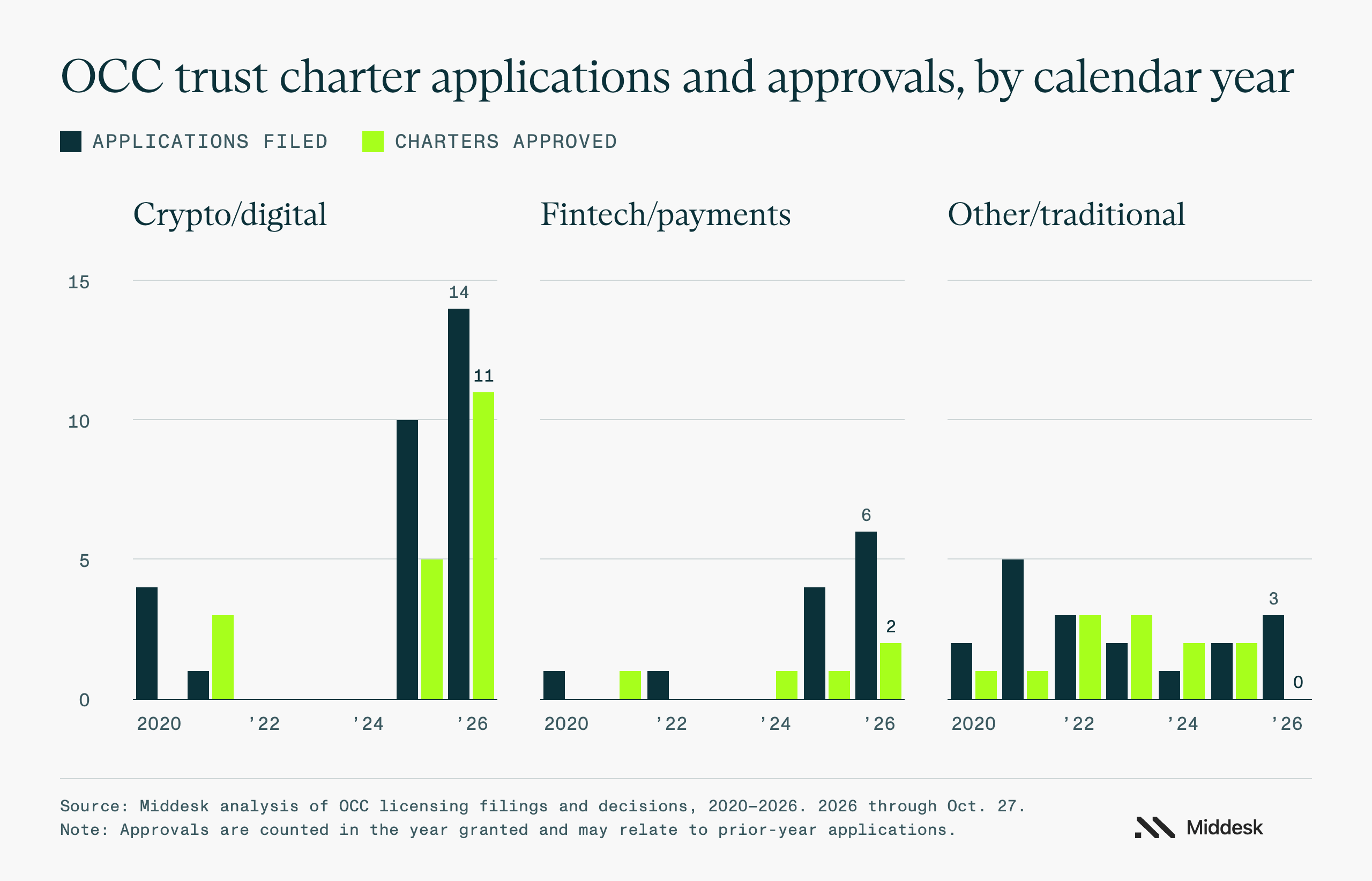
Ramp applied to the OCC to establish Ramp National Trust Bank, seeking a national trust bank charter to provide fiduciary asset management and corporate digital asset custody. The uninsured trust charter allows the spend management platform to custody corporate treasuries directly under federal supervision without requiring state-by-state trust licenses or retail deposit insurance.
The buy now, pay later provider Sezzle also submitted applications to the OCC for a full-service national bank charter and to the Federal Deposit Insurance Corporation for deposit insurance to establish Sezzle Bank, N.A. The charter would allow Sezzle to originate installment loans and offer consumers checking and savings accounts directly. This would mean Sezzle would no longer rely on partner banks such as WebBank.
The filings are part of an accelerating push by fintechs to gain direct access to central bank clearing rails and lower funding costs through primary customer balances. Community banking groups continue litigation challenging the OCC’s authority to grant national charters to non-depository fintech companies.
Bank executives and regulators draw battle lines over agentic commerce during Money20/20
Bank and fintech executives and a federal regulator discussed the risks and oversight of agentic commerce. Some said they’re worried about fraud possibilities with AI agents.
“There’d have to be a massive liability shift that these guys took on the liability associated with breaking all the crap they’re about to break… You’re messing with people’s lives. It’s money,” said PNC Financial Services CEO Bill Demchak.
“We are continuing to think about future guidance in that area,” said FDIC Chair Travis Hill, discussing generative and agentic AI at an Axios event in Las Vegas.
“I think that we’re going to have a scary year, from a security perspective,” said Plaid CEO Zach Perret.
A know-your-agent process is needed “to make sure that we have the right guardrails and we’re meeting the regulators’ demands as well,” said Citigroup global head of AI, digital and data platforms within Citi’s services business. Naveed Anwar.
Tokenized deposits and stablecoins advance across retail and enterprise rails
SoFi launched SoFi Earn, introducing SOFIE as a consumer tokenized deposit that pays a 4.40% annual percentage yield with federal deposit insurance up to statutory limits. In Hong Kong, HSBC deployed its Hong Kong dollar-pegged RedCoin stablecoin to 3.3 million retail users on its PayMe wallet. The Standard Chartered-backed Anchorpoint delayed its planned retail stablecoin launch citing evolving reserve and yield regulations. Mastercard introduced Stablecoin Security, an enterprise compliance tool designed to evaluate counterparty wallet exposure and sanctions risks before digital transactions settle on public blockchains.
Central Bank of Ireland fines Coinbase €3.25 million over safeguarding failures
The Central Bank of Ireland said Coinbase’s Irish subsidiary placed excessive reliance on its United States parent company, Coinbase Group, to execute client fund protections between November 2020 and August 2025 without maintaining adequate local oversight.
Regulators determined that Coinbase Ireland lacked the managerial staff and independent audit processes in Dublin to verify that outsourced operational functions complied with European safeguarding rules, which require institutions to segregate consumer balances into protected accounts. The enforcement action marks the second major regulatory sanction against Coinbase by Irish authorities and underscores European scrutiny on digital asset firms operating local subsidiaries with minimal autonomous oversight ahead of the Markets in Crypto-Assets regulation.
Zip takes $7.2 million fraud hit in United States operations
Australian buy now, pay later provider Zip Co disclosed in its first-quarter trading update that an external fraud incident in the United States resulted in $7.2 million worth of direct cash operating expenses. The company reported that coordinated rings established thousands of customer accounts using legitimate stolen personal information to execute retail transactions without intending to repay installment balances, prompting emergency credit tightening that temporarily slowed customer acquisition and transaction volumes in July and August.
Research published last week by credit bureau TransUnion revealed that 81% of suspected digital fraud attempts in early 2026 targeted established customer relationships and authorized payment channels rather than newly opened accounts. Zip said it notified law enforcement and submitted an insurance claim, while forecasting that net bad debts will moderate in the second quarter following the deployment of enhanced verification controls.
The deposit flight worry has some math behind it. FDIC's October national savings rate is 0.38% vs effective fed funds at 3.88%, so a reward that passes through even part of that gap beats a lot of bank savings accounts.