


Here’s our second roundup of the biggest things happening in our corner of the world.
The main thing this week: stablecoins.
Last week, the Fed proposed its first rules for bank-issued stablecoins under the GENIUS Act. Then, yesterday, a Senate subcommittee dropped a report detailing how Iranian oil smugglers and militant groups rely on Tether’s stablecoin to bypass U.S. sanctions. (Tether said it supported freezing about $550 million in cooperation with U.S. law enforcement)
AI agentic commerce is here and big banks want to establish principles that will govern how that works. In Italy, AI fraud also hit a bank, when criminals impersonated a bank lawyer using what investigators believe was a deepfake voice clone.
This week we’ll be looking out for Fed Governor Christopher Waller's remarks on payments infrastructure at the Sibos conference, the Bureau of Economic Analysis's annual benchmark revisions to gross domestic product on Wednesday, and the September employment report on Friday.
Federal Reserve opens GENIUS Act stablecoin rulemaking as banking trades demand non-bank scrutiny
Last week, the Fed Board proposed its first set of rules that would put the GENIUS Act’s framework into practice. One rule sets operating requirements, while the other explains how the Fed would assess applications, including banks’ business plans and finances.
Issuers would have to fully back their stablecoins with approved assets, such as cash and short-term Treasury bills, and hold capital to absorb certain losses. The proposed rules also cover risk management and the safekeeping of assets backing the coins.
Fed governor Michael Barr supported released the proposals for public comment but said more work was needed before stablecoins could be reliable payment instruments. Barr called for feedback on protection against interest-rate and currency risks and clearer rights for holders to get their money back. He also questioned a provision that would prevent the Fed from taking supervisory or enforcement action over money-laundering deficiencies unless they were “significant or systemic.”
The GENIUS Act is moving quickly and traditional banks aren’t enthralled. In July, the OCC proposed application and registration forms asking prospective stablecoin issuers for business plans, reserve and repayment policies, and information about management and risk controls.
On Friday, the Bank Policy Institute, American Bankers Association and two other banking groups urged the OCC to let the public weigh in on applications to issue stablecoins. They also called for closer checks on applicants that aren’t owned by insured banks, including how they manage risk, protect against cyberattacks and recover from disruptions.
Senate investigation details how Iranian groups use stablecoins
A report released Monday by Sen. Richard Blumenthal (D., Conn.) identified Tether’s USDT stablecoin as the primary cryptocurrency used in Iran’s shadow banking system.
Subcommittee investigators traced more than $603 million in USDT moved by two sanctioned Iranian oil smugglers between 2021 and 2025 through a network connected to Hezbollah, the Houthis and Iranian financial institutions.
Tether said it has supported freezing approximately $550 million in Iran-linked USDT in 2026 across global law enforcement requests and argued that public blockchain transparency provides superior tracing compared to cash.
The Senate findings followed the seizure of $84 million across bank accounts held by Montana-based payment processor Capstone. Prosecutors allege Capstone moved money for Tether and crypto exchange Bitfinex without the required license, using a bank in Dominica.
Kansas Fed study shows B2B ACH transaction volume outpaces checks
A research briefing published by the Federal Reserve Bank of Kansas City shows that ACH has overtaken paper checks as the primary volume rail for B2B transactions. It also shows that paper checks continue to clear a massive corporate dollar value despite wide adoption of the ACH method.
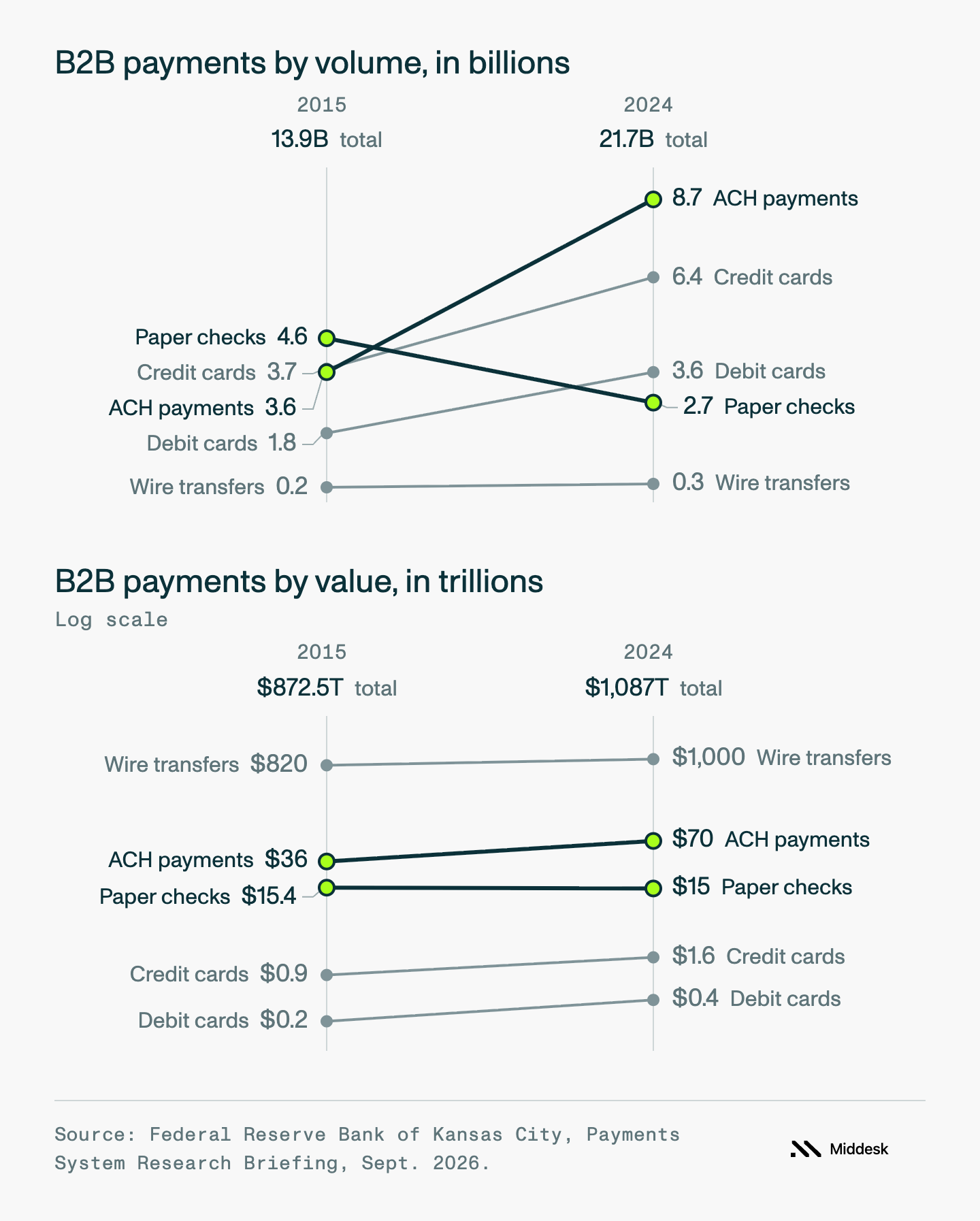
A survey from the Association for Financial Professionals had 87% of respondents saying they still write paper checks for vendor disbursements. The persistence of checks across businesses indicates that corporate migration to electronic clearing remains slowed by manual invoice reconciliation, vendor onboarding friction, and disparate accounting software.
Fees could also explain why checks are still here. Card fees typically charge the recipient a percentage of the payment, making large invoices expensive to accept. ACH bank transfers generally carry a flat per-transaction fee and cost less than checks, making them a close substitute, the briefing said.
Bank of America and five other global banks propose governance principles for AI agentic commerce
A consortium of six commercial banks—Bank of America, Capital One, NatWest Group, ING Group, Commonwealth Bank of Australia, and New Zealand’s ASB Bank—published a set of principles for consumer AI agentic commerce.
The banks define five baseline principles: transparency, safety, privacy, choice, and interoperability. They said these can establish common guardrails around agent identification, user delegation, transaction audit trails, and multi-party liability.
The principles touch on mechanisms already appearing in the market, like “intent mandates” and identifying the merchant of record. The paper follows the deployment of agentic commerce protocols, such as Google’s Agent Payments Protocol and an open-source standard from Stripe and OpenAI.
The bank consortium announced plans to detail protocol implementations, industry standards, and policy mechanisms in a subsequent paper, inviting tech developers, payment networks, merchants, and regulators to collaborate on shared standards.
Italian private bank hit by €95 million AI voice-clone executive impersonation fraud
Fraudsters used AI voice clones to steal €95 million (about $108 million) from Fideuram, the private banking arm of Italy’s largest lender, Intesa Sanpaolo.
The scheme began in February when Fideuram’s then-chairman, Paolo Molesini, received a WhatsApp message purporting to be from Intesa CEO Carlo Messina. It requested urgent help with an overseas deal that supposedly needed to go through Fideuram’s treasury.
The scammers followed up with a call appearing to confirm the request. Investigators believe they used AI to clone the voice of Paolo Nastasi, the head of law firm A&O Shearman’s Italian operation. Molesini then told his staff to wire money to accounts mainly in China and Hong Kong.
Authorities in Italy, China and Portugal helped recover much of the money, but about €36 million remains missing. They said the remaining funds had passed through overseas accounts and been converted into cryptocurrencies. Milan prosecutors are investigating a suspect living outside Europe for computer fraud.