


We’re starting a new section of the Brief called Weekly Context, which will run on Tuesdays. We’ll share the week’s most important stories and give you the context you need to understand what’s happening at the intersection of business, regulation, and fraud.
Last week, Treasury Secretary Scott Bessent previewed changes to half-century-old anti-money laundering thresholds and crypto legislation stalled in the Senate.
This week, the House Financial Services Committee will hold hearings on prudential regulators and the future of central banking.
In enforcement news, a former bank chief executive was sentenced to prison, while payments management firm Corpay agreed to a $100 million settlement over small-business fuel-card fees.
Treasury considers higher AML thresholds
Bessent told lawmakers last week that the Treasury is drafting revisions to the $10,000 anti-money laundering reporting threshold. He said the draft would give banks more flexibility based on how long they have known a customer, while keeping attention on criminal financing.
The move follows years of criticism from banks and credit unions, which say compliance officers file millions of reports to avoid examiner penalties even when the information has little investigative value. FinCEN’s filing data shows that annual suspicious activity reports rose from 1.66 million in 2014 to 3.80 million in 2024, while currency transaction reports exceeded 20 million annually in recent fiscal years.
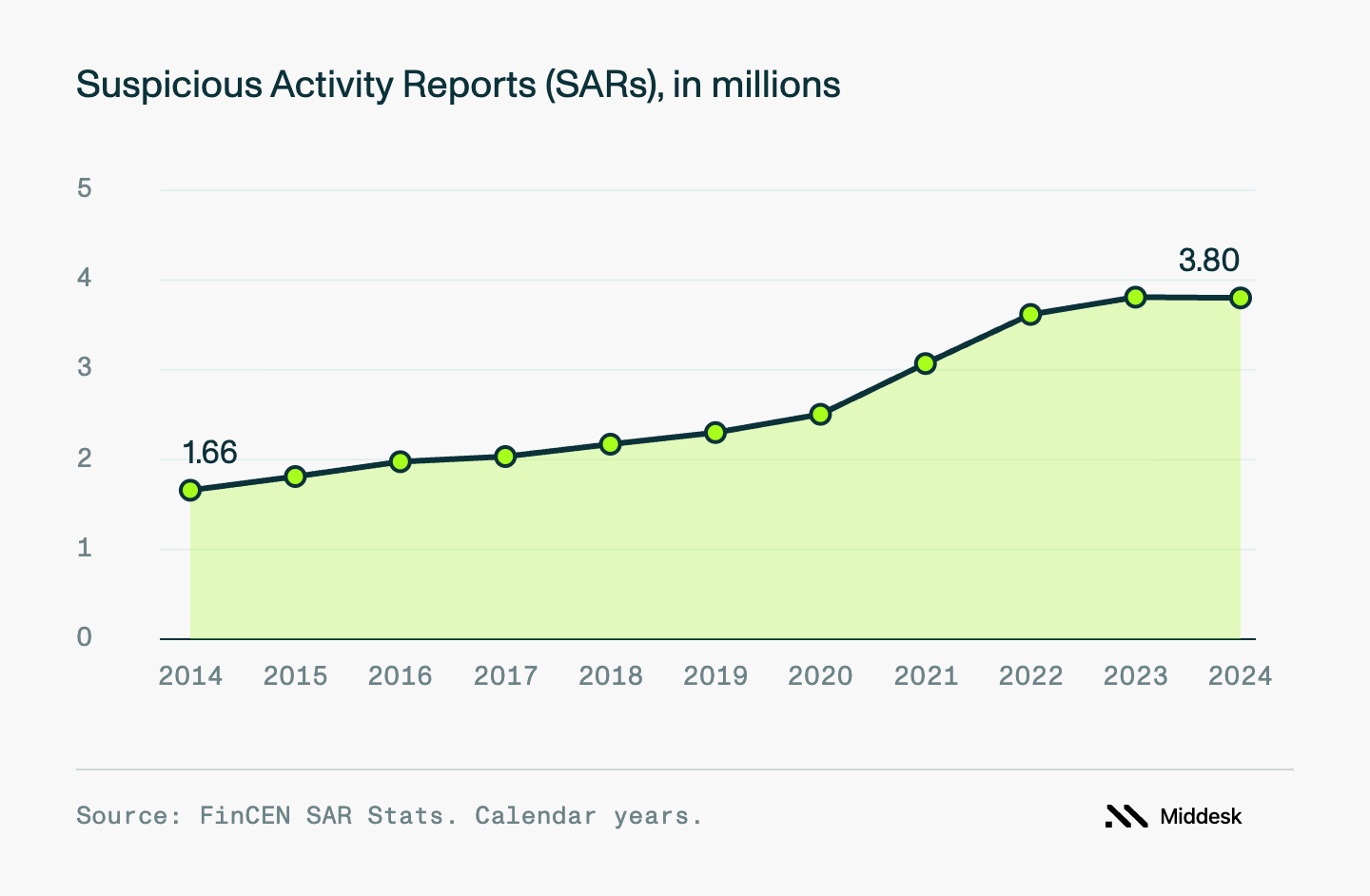
The proposal isn’t final, and Bessent did not give a timetable.
The current $10,000 threshold for Currency Transaction Reports was established by regulation under the Bank Secrecy Act in 1972 and has never been adjusted for inflation. If it were, that threshold would now exceed $70,000.
Treasury can change the currency-reporting threshold through rulemaking, but broader changes to suspicious-activity reporting would face different legal and supervisory constraints.
The Defense Credit Union Council and the Independent Community Bankers of America pressed Treasury to raise the cash threshold to at least $30,000 and index it to inflation every five years.
What else we’re following
The Senate blocked the CLARITY Act
The Senate voted against opening debate on the Digital Asset Market Clarity Act, falling short of the 60 votes required to proceed. The bipartisan bill was intended to establish federal market rules by dividing oversight between the Commodity Futures Trading Commission and the Securities and Exchange Commission. The crypto industry backed the measure to secure clear statutory boundaries, while Democratic lawmakers raised concerns over ethics rules for government officials.
The American Bankers Association and the Bank Policy Institute argued that allowing nonbank stablecoin issuers to pay interest would drain deposits from community lenders and undermine the commercial banking system. The procedural defeat leaves digital-asset firms operating under existing securities and commodities laws, without the clearer SEC and CFTC boundaries the bill sought to establish.
BPI challenges ZeroHash’s revised national trust-bank application
The Bank Policy Institute asked the OCC to reject a renewed charter application from crypto firm ZeroHash. The agency had returned the first application without publicly explaining why. Firms like ZeroHash are looking for national trust-bank charters that place their operations under federal banking supervision without requiring FDIC deposit insurance or subjecting their parent companies to commercial bank holding rules.
Last week, BPI said in a comment letter that ZeroHash’s August revised application simply added the word “fiduciary” to its activities without changing how its settlement, clearing, and escrow services actually operate. The trade group contends that standard commercial crypto processing does not meet the legal definition of trust activities, and warned that approving the charter would give digital-asset firms federal preemption without standard bank safety nets.
BPI has also opposed applications from Ripple, Circle, Paxos, Coinbase, and Kraken’s Payward.
Corpay resolves FTC action over fuel-card fees for $100 million
Corpay, formerly FleetCor Technologies, and its chief executive agreed to pay $100 million to resolve a Federal Trade Commission lawsuit over hidden charges on commercial fuel cards sold to small businesses. The FTC alleged that the company advertised per-gallon fuel savings and promised that customers would pay no setup or membership fees, but later added unexpected program charges, minimum-usage fees, and late penalties that erased the promised discounts.
The order concludes litigation filed in 2019. A federal district court granted summary judgment against FleetCor in 2022, finding its fee disclosures deceptive, and a federal appeals court upheld that finding earlier this year. The $100 million will go toward customer restitution.
Former bank chief executive sentenced over wire fraud
Yesterday, a federal court sentenced Tomás Niembro Concha, former chief executive of Puerto Rico-based Nodus International Bank, to more than nine years in prison for his role in a wire-fraud conspiracy that siphoned at least $24.9 million from the institution and led to its liquidation in 2023.
Court filings show Niembro and his partners concealed that bank investments and loans went to companies they controlled, while separately conspiring to evade U.S. sanctions involving a designated Venezuelan national. The court also ordered Niembro to forfeit more than $16.9 million.