


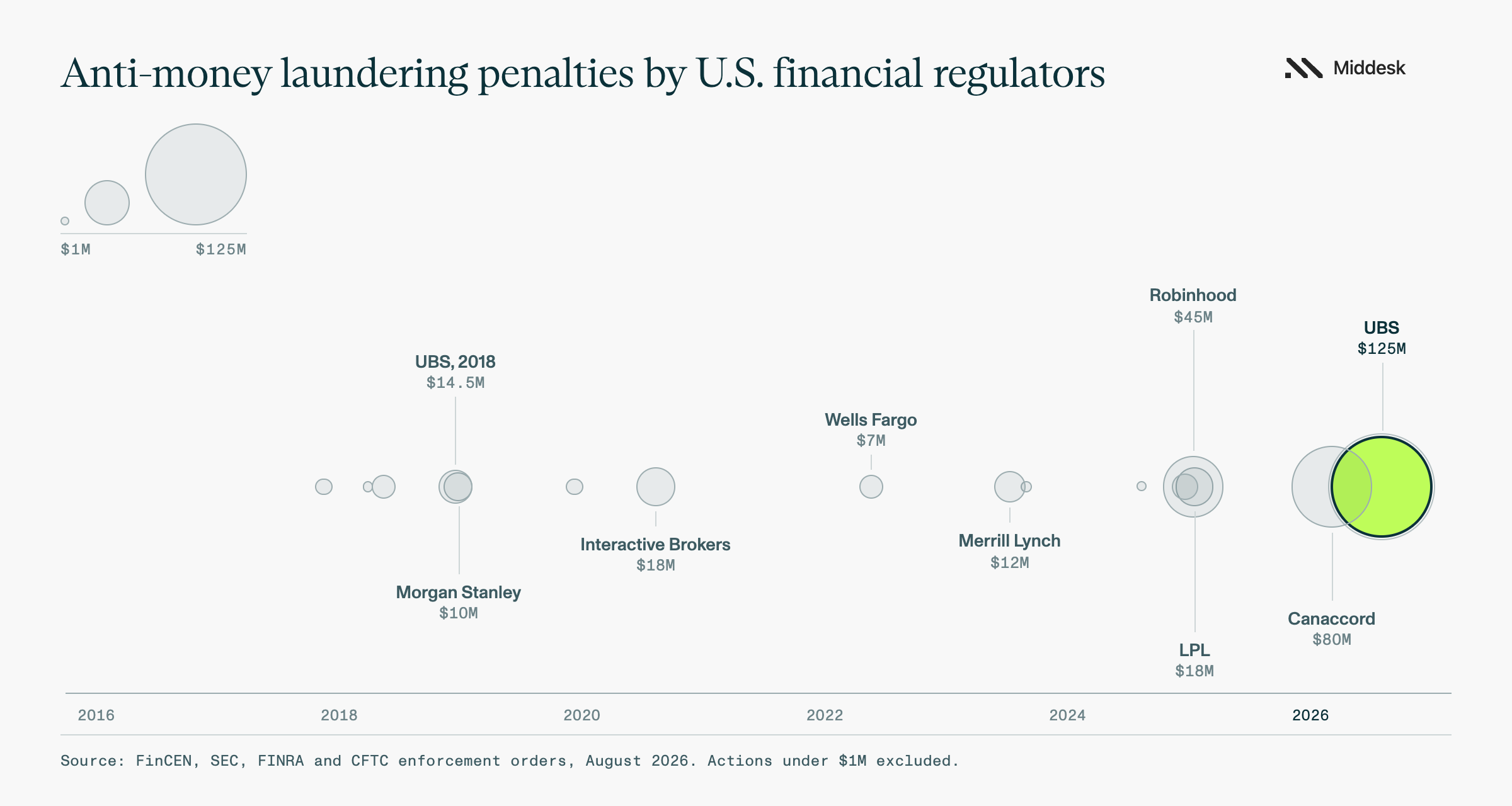
Last week FinCEN issued an order with its largest ever penalty on a broker-dealer for Bank Secrecy Act violations. A whopping $125 million. 👀
Three other financial regulators also got involved and the four of them issued orders with details of how the bank repeatedly messed up for years. We pieced it all together to get a clear, step-by-step view of at least one example of how they dropped a massive, unmissable, just-google-it ball.
You’ll see I’m not being dramatic…
In 2021, former Fox News producer John Hanick moved more than $3 million in funds and securities into newly opened UBS brokerage accounts. He told the bank the money came from a consulting firm he had left three years earlier.
Hanick had actually worked for Konstantin Malofeev, a Russian oligarch sanctioned in 2014 for financing pro-Russian separatist rebels in Crimea. So the consulting gig was in fact Hanick’s years of helping set up the Fox News-inspired Russian TV network, Tsargrad. The Financial Times reported as much in late 2015 and Salon in 2018.
A financial advisor at UBS knew Hanick had worked in Russia but left it out of the producer’s file, breaking the bank’s own anti-money laundering rules. Without that detail, Hanick received a low-risk rating, which meant he didn’t go through an enhanced due diligence review, an extensive review required for customers presenting greater risk.
Last week, the Financial Crimes Enforcement Network slapped UBS with a $125 million penalty for recidivist and willful Bank Secrecy Act violations, the largest ever AML fine imposed on a broker-dealer and FinCEN’s second action against the bank. The regulator said that between January 2019 and June 2023, UBS failed to monitor more than 61,500 foreign currency wires worth over $10.5 billion and breached its own customer due diligence rules for high-risk customers.
Hanick’s episode is one of several examples listed in orders released by FinCEN, the Financial Industry Regulatory Authority, the Commodity Futures Trading Commission and the Securities and Exchange Commission. The orders show how UBS’s anti-money laundering program missed red flags or failed to act on them.
UBS has admitted to FinCEN that the violations were willful and has agreed to work with a third party to review the transactions. Its anti-money laundering program will go through an independent review as well. The orders don’t name Hanick but together the details from the four orders match the dates and story of the Fox News producer and his relationship with the oligarch.
The bank’s internal checks did not find Hanick’s publicly reported relationship until shortly before he was indicted for U.S. sanctions violations in March 2022. The bank made the connection when Hanick’s spouse applied for a $1 million line of credit. UBS later filed a suspicious activity report and exited the relationship only after Hanick’s indictment was unsealed.
Why UBS received a record AML penalty
FinCEN called the UBS penalty “the largest penalty ever imposed against a broker-dealer for BSA violations to date.” Regulators have brought related cases against other broker-dealers, but those cases involved different rules, narrower failures or additional violations.
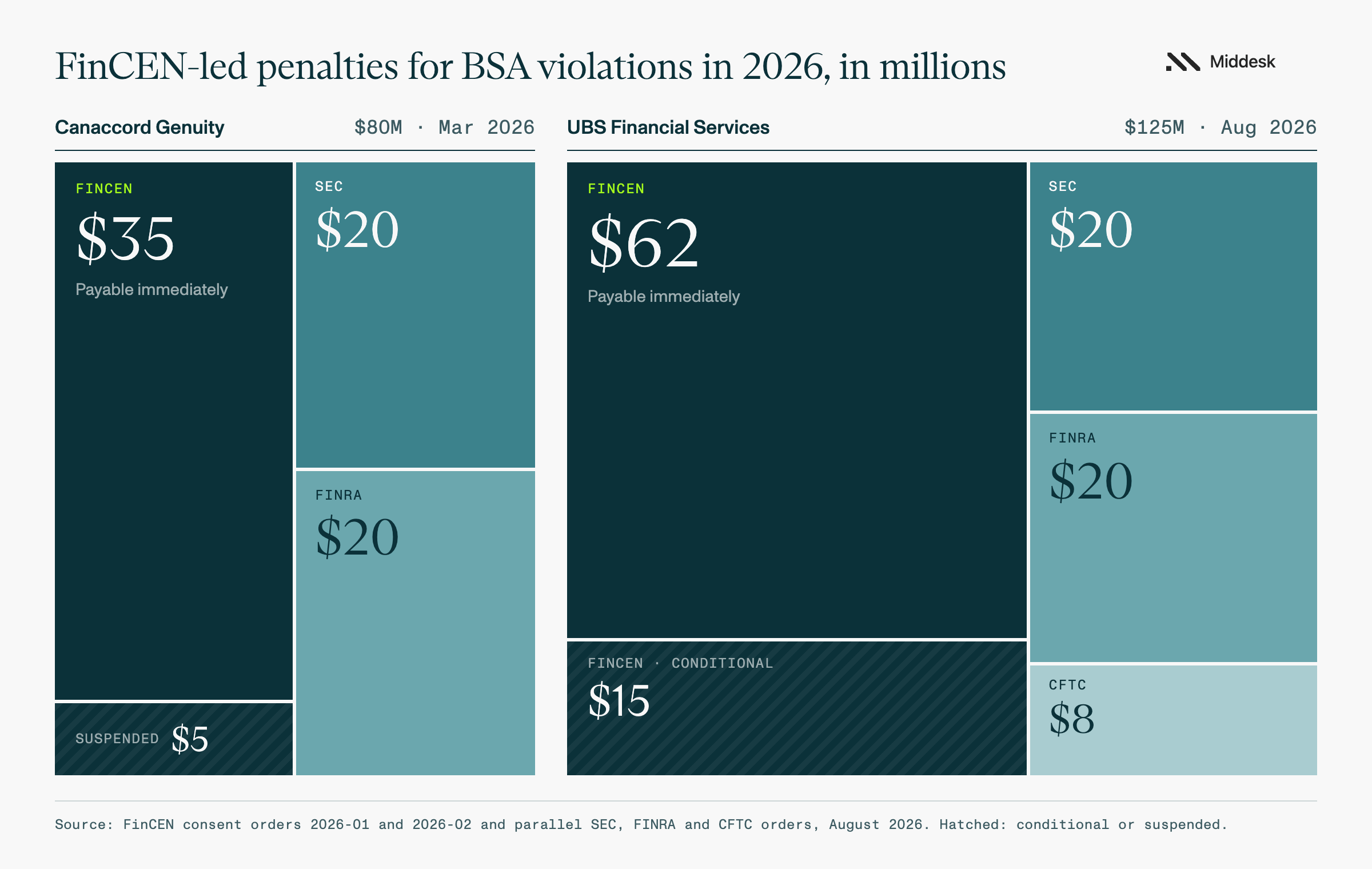
The $125 million UBS penalty includes payments to four regulators. UBS must pay $62 million to the Treasury, while the SEC, FINRA and the CFTC will receive $20 million, $20 million and $8 million. FinCEN credits those payments against the total. Another $15 million may be waived if UBS completes an independent review and pays for improvements to its anti-money laundering program.
FinCEN also issued a record $80 million penalty in March to Canaccord Genuity for failing to monitor trading in low-priced stocks. The regulator said Canaccord did not file at least 160 suspicious activity reports. Its problems were similar to UBS’s: weak monitoring, weak customer reviews and missed reports.
These cases arise from similar failures in compliance programs, such as missing obvious red flags, filing late or incomplete suspicious activity reports and allowing customer profiles to go stale. Merrill Lynch, for example, used the wrong reporting threshold and missed about 1,500 reports. LPL Financial left thousands of accounts open even though its own policies required the firm to restrict or close them.
Canaccord and UBS drew the two largest broker-dealer BSA penalties in part because regulators found failures extending beyond individual transactions into customer reviews, data feeds, monitoring systems and management oversight.
How UBS’s transaction monitoring failed
UBS was fined in 2018 for similar problems. The bank had promised regulators to replace the deficient process monitoring foreign-currency wires with automated monitoring by the middle of 2019. UBS executives knew the promised deadline wasn’t feasible but chose not to tell FinCEN.
While the new process was set up, employees had a manual process that took a dozen steps to manually query four different systems and then copy the data points into an Excel spreadsheet. An SEC order said that roughly 52,000 wires worth $7.6 billion were not adequately monitored until the new system was implemented in February 2021.
FinCEN said an internal lookback UBS ran during that period produced no suspicious activity reports, including on transactions involving a customer under investigation for money laundering and tax evasion, and a “Mexico-based customer who was involved in alleged fraud and was later kidnapped and murdered.”
UBS never mapped how wire data traveled between its systems and didn’t verify that the transactions reached the monitoring software. The system was regularly fed a 4:00 p.m. data extract, missing everything that came after. Then it missed more foreign transactions after an operations team changed a transaction label that was not updated in the monitoring system.
The SEC said that between February 2021 and June 2023 roughly 4% of 190,000 wires were not adequately monitored under the new system. Those transactions made up 20% of the value moved, or $2.7 billion.
The high-risk customers UBS misjudged
Other cases followed the same pattern as Hanick’s. UBS opened six accounts for a Russian oligarch with ties to Vladimir Putin because he held $1.5 billion at a UBS affiliate and hadn’t been charged with a crime. When reports tied him to a scheme moving billions of euros offshore, his UBS advisor recommended the bank disregard the news.
A college professor moved to Russia by 2014 to work for a research institution affiliated with a man sanctioned in 2018. UBS kept listing his U.S. university as his source of wealth and left him rated low risk. An employee added a Russian phone number to his file in 2019 without reassessing his rating and the same happened again in 2021, after two analysts found public information about his Russian job.
UBS changed the rating in 2022 during an internal review and filed a SAR in July, covering eight years and 23 incoming wires worth more than $2.2 million.
A group including a former UBS advisor opened more than 40 accounts for dozens of shell companies across multiple branches, making one set of investors look like many so they could claim a bigger share of sought-after IPO stock.
FinCEN said the scheme survived mainly because UBS never checked whether the companies shared owners. The group’s shells listed mailbox services and submitted blank due diligence forms but UBS failed to spot those until a regulator asked about one of the accounts.