


A couple of hours after we published last week’s Rundown, Bank of America got slapped with a $1.2 billion fine from regulators for weak anti-money laundering controls.
Last week, federal investigators zeroed in on multi-million dollar fraud schemes targeting government programs and seniors.
A lot of the fraudsters launder money easily through domestic banks by opening bank accounts that get approved because of weak checks. (We’ve reported on those penalties and checks in previous editions of The Brief.)
Back to the Rundown:
Bank of America faces $1.2 billion in combined anti-money laundering penalties from the Financial Crimes Enforcement Network and the Office of the Comptroller of the Currency.
JPMorgan Chase blocked AI agents from accessing customer accounts
Wells Fargo confirmed infrastructure preparations for a 21-bank consortium aiming to issue a commercial dollar-pegged stablecoin in 2027.
FinCEN identified $270 million in suspicious transactions tied to organized student aid schemes.
The Federal Trade Commission warned that fraud losses reported by older adults surged to $3 billion.
This week, we are watching closed Federal Reserve briefings on financial institution stability, the Commodity Futures Trading Commission's AgCon summit exploring artificial intelligence and prediction markets, and September business formation data.
Bank of America penalized record $1.21 billion over automated compliance gaps
The OCC and FinCEN said Bank of America had systemic anti-money laundering and sanctions screening failures. The OCC assessed a $750 million civil penalty—the largest in the agency’s history—which is credited against FinCEN’s $1.2 billion assessment. The bank admitted to willful violations of the Bank Secrecy Act without contesting the findings.
Examiners said the Bank of America failed to maintain automated transaction monitoring systems that could review trillions of dollars in daily payment flows. The agency found the bank neglected to escalate flagged transactions to internal investigators, allowed significant operational backlogs to accumulate, and processed suspected trade-based money laundering transactions through unmonitored channels. The failures persisted despite a December 2024 supervisory cease-and-desist order that required the bank to fix core compliance systems.
In response, Bank of America announced it repositioned approximately 1,000 compliance employees and accelerated internal operational spending. CFO Alastair Borthwick told analysts the bank had made substantial fixes across transaction screening models.
The order requires Bank of America to submit a comprehensive compliance remediation plan, hire an independent consultant to conduct a retrospective transaction lookback, and overhaul customer due diligence across correspondent banking relationships. The penalty is the third-largest enforcement action in Treasury Department history, following earlier sanctions settlements with international lenders BNP Paribas and TD Bank.
JPMorgan stops artificial intelligence spending agents
The bank barred outside AI agents and third-party automated software from accessing customer accounts using stored banking credentials. CEO Jamie Dimon warned during last week’s earnings call that customers using AI agents need to understand the risks. “They should understand there’s a liability transfer,” he said.
Other firms are taking another apporach. American Express introduced an open-source standard titled the Intent Intelligence Framework, engineered to cryptographically anchor a consumer’s authorization parameters directly to an autonomous agent’s transaction tokens. Stripe, Meta and customer-service AI company Sierra are among the companies developing the Personal Agent Protocol, known as Poppy. Wells Fargo, Bank of America, BBVA and Synchrony are design partners in the draft standard, which lets customers authorize an agent while businesses specify what it can do.
Wells Fargo prepares infrastructure for 21-bank stablecoin consortium
Wells Fargo CEO Charlie Scharf confirmed last week that the bank is developing core treasury integrations to join a 21-member banking alliance planning to issue a regulated commercial stablecoin in 2027. Scharf recently said that commercial banks must establish shared distributed ledger rails to avoid ceding payment settlement market share to non-bank fintechs. The alliance, which includes major domestic and European lenders, intends to deploy an asset-backed token pegged to the U.S. dollar to settle cross-border corporate payments and institutional repo transactions. Depository institutions are increasingly turning to joint ventures to deploy blockchain rails within existing prudential frameworks.
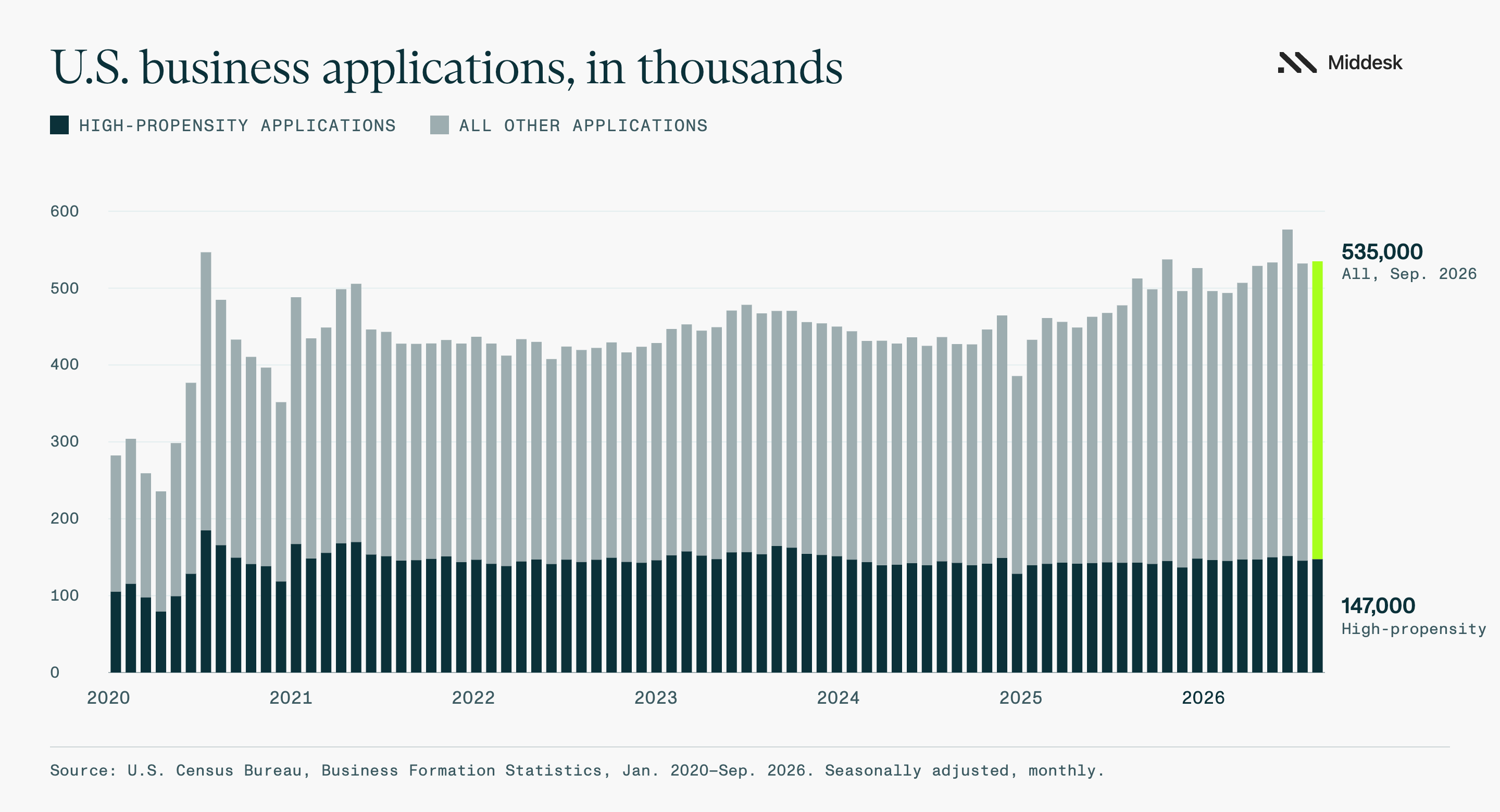
Business applications rebound in September
Census data tells us that more businesses are submitting applications, but a shrinking share are likely to hire.
New business applications in the United States rose 0.5% in September to a seasonally adjusted 534,947 filings, according to the monthly Business Formation Statistics published by the Census Bureau. The modest uptick followed a contraction in August, showing stable commercial formation activity across corporate services, online retail, and regional trade despite elevated borrowing costs. High-propensity applications, or those with a high likelihood of establishing operational payrolls, advanced to 147,331 filings for the month.
OCC investigation finds major banks exited customers over reputational risk
The OCC released a supervisory report last week concluding that the nation’s largest commercial banks systematically terminated or restricted deposit accounts for lawful commercial enterprises using subjective reputational risk policies. Initiated under an executive order reviewing fair banking access, the inquiry reviewed compliance records across the nine largest chartered depository institutions, including JPMorgan Chase and Bank of America. The findings followed a joint proposed rulemaking published by the agency and the Federal Deposit Insurance Corporation that would formally bar examiners from criticizing institutions over reputational risk or encouraging account closures based on a customer’s lawful political or religious views.
JPMorgan Chase publicly challenged the claim that it engaged in systematic bias, emphasizing that its policies expressly prohibit political and religious discrimination.
A Cato Institute analysis by Nicholas Anthony said that despite reviewing nearly 100,000 customer complaints and 420,000 pages of bank records across 2020–2025, the agency identified only about 13 specific instances of suspected political or religious debanking across the nine largest banks. “It’s hard to land on the ‘irrefutable’ conclusion that systemic discrimination against conservatives and Christians is taking place in banking,” Anthony said in his report.
FinCEN uncovers $270 million in synthetic student aid fraud schemes
FinCEN said it identified approximately $270 million in suspicious banking activity tied to organized fraud rings exploiting federal student aid programs. Acting on tip-and-lead data generated by financial institutions, the bureau referred the findings to the Department of Education Office of Inspector General and federal prosecutors to initiate criminal investigations and asset freezes. The referrals stem from an analytical review of nearly 100 suspicious activity reports that mapped more than 20,000 anomalous transactions since February.
The criminal networks exploit two primary mechanisms to divert federal financial aid into commercial accounts. In ghost-student schemes, fraudsters use stolen personal data and synthetic identities to enroll fictitious students in online courses and capture automated electronic refund transfers. In straw-student operations, rings pay cash kickbacks to real individuals to enroll in degree programs, siphoning excess grant disbursements through commercial shell companies and money mule accounts.
The bureau instructed commercial banks to intensify transaction monitoring around incoming automated clearing house refund drafts containing institutional identifiers.
FTC reports older adult fraud losses climbed to $3 billion
Reported fraud losses suffered by adults aged 60 and older surged to $3 billion in 2025, up from $600 million in 2020. The agency estimated that the total economic impact of elder fraud reaches as high as $119.5 billion annually when unrecorded victimizations are factored into statistical models. That number is based on consumer submissions to the Consumer Sentinel Network.
The financial damage was driven by investment fraud, which accounted for more than $1 billion in reported senior losses during 2025—a 42% increase in a single year. While older consumers filed loss reports less frequently than younger demographics, individual dollar losses were severe, with victims aged 80 and over reporting a median loss of $2,000 compared to $500 for younger adults.
Scammers established contact through social media platforms and directed victims to wire funds, purchase physical gold bullion, or deposit cash into cryptocurrency kiosks. (That’s how pig butchering scams work. We wrote about those recently.)
The commission urged commercial lenders to establish transfer friction and protective monitoring on large-dollar outbound wires initiated by older customers.