


(Editor’s note: we’re renaming our weekly digest to the Rundown.)
Welcome to the Rundown!
Community banks are suing the Office of the Comptroller of the Currency. They want to block crypto firms from using uninsured national trust bank charters.
Everywhere else, it seemed, modernized banking pushed forward:
The Treasury Department established federal review rules for state-chartered stablecoin oversight
Fintech payments firm Fiserv launched a new stablecoin payment service
A Stripe subsidiary began issuing Open USD, a new stablecoin.
Central bankers examined the liability boundaries of autonomous AI agents.
This week:
The SEC and the CFTC are coordinating with global securities regulators for World Investor Week, focusing on AI-generated impersonation schemes and relationship investment fraud.
Fed vice chair for supervision Michelle Bowman will deliver a keynote on modernizing bank supervision at the 2026 Community Banking Research Conference. FDIC chairman Travis Hill will also speak at this conference, with a focus on community bank capital and regulatory burden.
More on all of it, below:
Independent community bankers sue the OCC over national trust charters for crypto firms
The Independent Community Bankers of America filed a lawsuit Friday challenging the OCC over its authorization of national trust bank charters for digital asset firms. The complaint asks the court to declare unlawful the agency’s March chartering rule and vacate Interpretive Letter 1176, alongside the conditional national trust charter granted to cryptocurrency custody provider Protego Holdings Corp.
“Congress did not create the national trust charter as a side door into the banking system,” said ICBA president and CEO Rebeca Romero Rainey in a statement.
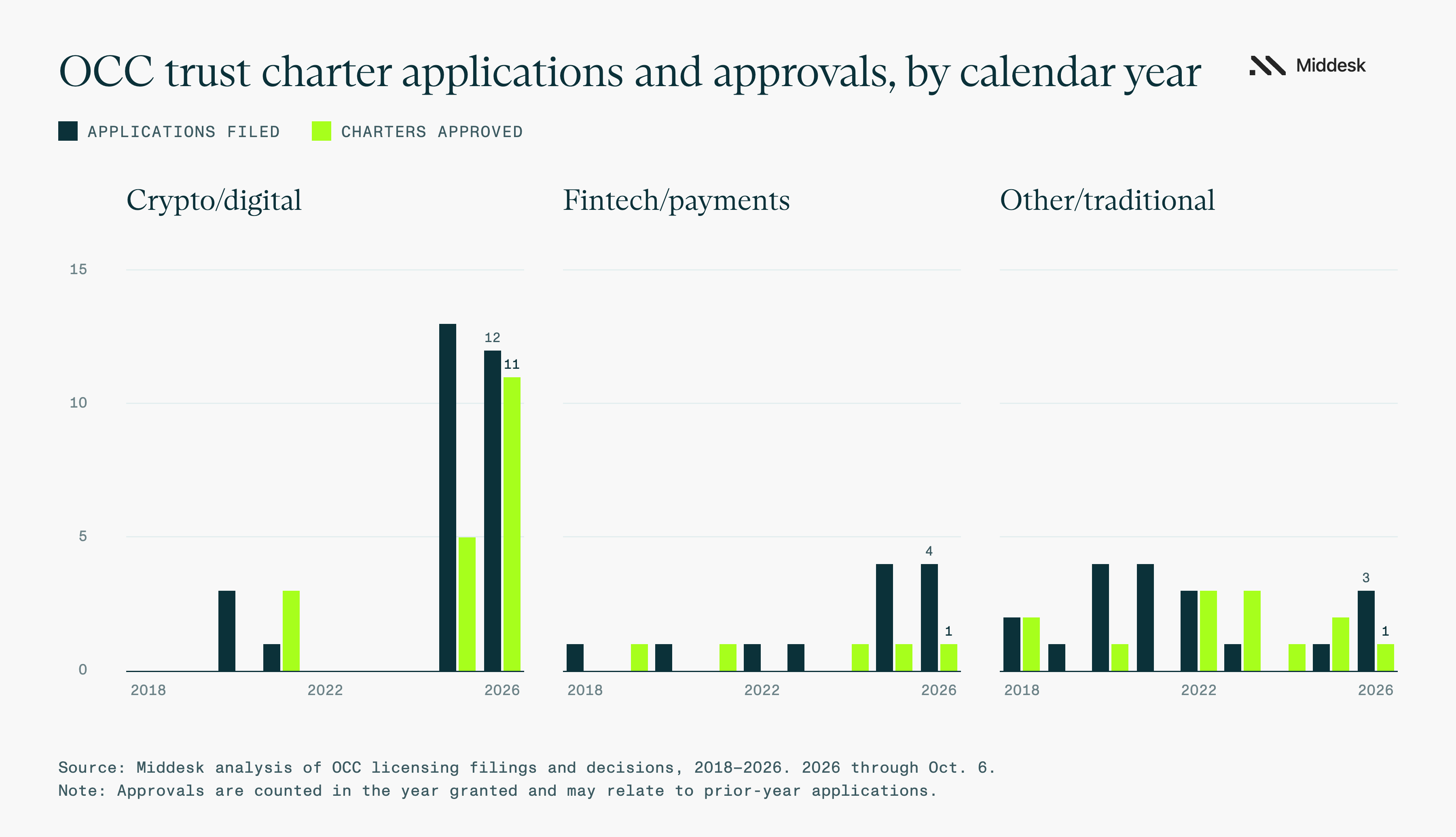
The ICBA said the OCC exceeded its statutory limits by establishing a fourth charter category: limited-purpose trust charters for novel entities conducting non-fiduciary digital asset activities. In doing so, the trade group said, the agency created an unvetted avenue into the national banking system. The community banks said that these charters let crypto firms avoid some state lending and licensing rules without taking on the same obligations as traditional banks.
The Bank Policy Institute, which represents the largest U.S. banks, supported the lawsuit and warned that crypto firms are getting an unfair advantage that could expose the banking system to risks.
The dispute goes back to the OCC’s 2021 conditional approval of crypto custodian Protego’s conversion to a national trust bank, which later expired in 2023. The agency conditionally approved a new Protego national trust bank in February and in March updated its chartering rules to explicitly allow trust banks to safeguard customers’ assets without managing them on their behalf. The OCC described the change as clarifying powers trust banks already had, rather than granting new ones.
Fed Governor and Mastercard talk agentic commerce at Sibos
Fed governor Christopher Waller said last week at Sibos that business purchasing could be a good proving ground for AI agents because companies already operate with approved suppliers and strict spending limits. He said that banks and payment companies would need ways to verify that customers had authorized agents to spend their money and adjust fraud systems built to recognize human behavior.
“Who is on the hook if an agent makes the wrong purchase?” Waller asked, arguing that there is a need to resolve responsibility for mistakes. He said clearer records of what buyers intended and what agents actually did could help settle disputes.
Mastercard executive Johan Gerber said banks and payment networks won’t decide whether to participate in agentic commerce because consumers and corporate buyers are choosing to give agents access to their payment details.
Commercial stablecoins expand across core banking and multi-chain networks as Treasury sets state review rules
The Treasury Department published rules last week explaining how states can seek federal recognition of their stablecoin oversight programs under the GENIUS Act. The law allows qualifying issuers with no more than $10 billion in outstanding stablecoins to choose state supervision if the state’s rules are substantially similar to federal requirements.
Fiserv, which supplies banking and payments technology, launched its Digital Asset Platform with Bank of North Dakota’s Roughrider Coin as its first live application. The dollar-backed stablecoin is designed to move money between banks and credit unions in the state through Fiserv’s existing online banking system. VersaBank issues the coin and manages its reserves.
The Stripe and Visa-backed consortium Open Standard launched Open USD, or OUSD, a dollar-backed stablecoin issued by Stripe subsidiary Bridge. Businesses can now use it for payments, international transfers, and trading, with fee-free conversion between dollars and tokens at a one-to-one rate. Its reserves are held at BlackRock, BNY, and Lead Bank, and the launch announcement lists integration options through Stripe, Visa, Mastercard, and Coinbase.
Guilty pleas expose business and customer impersonation in bank fraud cases
Two men pleaded guilty last week in an $11 million stolen-check scheme involving banks in New Jersey and Pennsylvania. Prosecutors said the group impersonated businesses and individuals named on the checks, obtained fraudulent business documents, and opened accounts to deposit the checks and withdraw the money.
Court records show that the fraud ring relied systematically on corporate identity theft to bypass commercial bank onboarding controls. The group obtained fraudulent state business registrations, forged corporate formation certificates, and registered companies matching the commercial payee names printed on stolen instruments. They also used the false documentation to open commercial depository accounts across regional financial institutions, deposited stolen checks, and rapidly withdrew funds.
Hester Peirce backs broader crypto custody options as she leaves the SEC
SEC commissioner Hester Peirce stepped down from the agency on Friday after an eight-year tenure as the commission’s leading advocate for digital asset regulatory clarity. Last week, she supported a proposal giving investment advisers and regulated funds more options for safeguarding clients’ crypto assets. Peirce called the previous approach a “regulatory roller coaster” that made compliance difficult.
The proposal would let advisers hold certain client crypto assets themselves, subject to safeguards, when no permitted custodian is available. It would also allow eligible state trust companies to provide custody services. Peirce distinguished advisers holding assets for clients from investors holding their own crypto, urging regulators to protect that choice. The changes remain a proposal open to public comment, not rules advisers can use yet.
FinCEN signals further action on immigration-related banking rules
FinCEN said last week that further steps to implement President Donald Trump’s immigration-related banking order were coming. Speaking at an ACAMS conference in Las Vegas, official Jackie Blasei-Freed confirmed that changes to customer due-diligence rules were pending. A draft had reached White House review, but its contents remained private, according to ACAMS.
The May executive order directed Treasury to propose changes preserving banks’ authority to request immigration and work-authorization information when relevant to financial-crime risks. It also directed regulators to consider changes to customer identification rules, including the treatment of foreign consular IDs.