


In recent weeks everyone has been talking about what’s going on with Dodgers owner Mark Walter and his insurer empire. He’s been under federal scrutiny since last year for some suspected self-dealing between his companies that was not adequately disclosed to policyholders.
It’s a complex set of transactions that are now being investigated for potential fraud. Middesk has Secretary of State records and UCC filings, so we looked at millions of records to try and break it down for you.
Guggenheim Partners co-founder and CEO Mark Walter had owned the Lakers for barely a year when Joshua Kushner and former Disney chief Bob Iger made him a $12.5 billion unsolicited offer for the team.
Walter accepted within 72 hours.
The sale came as federal prosecutors and the Securities and Exchange Commission investigate whether Walter’s private-credit financing operations were fraudulent. Parts of his empire—which includes the Dodgers—appear to have been built through private-credit deals between two insurers he controlled and other companies he owned.
In June, Walter-controlled insurers Delaware Life and Clear Spring Life said a subpoena-sparked internal review found classification errors affecting about $16 billion in private-credit investments.
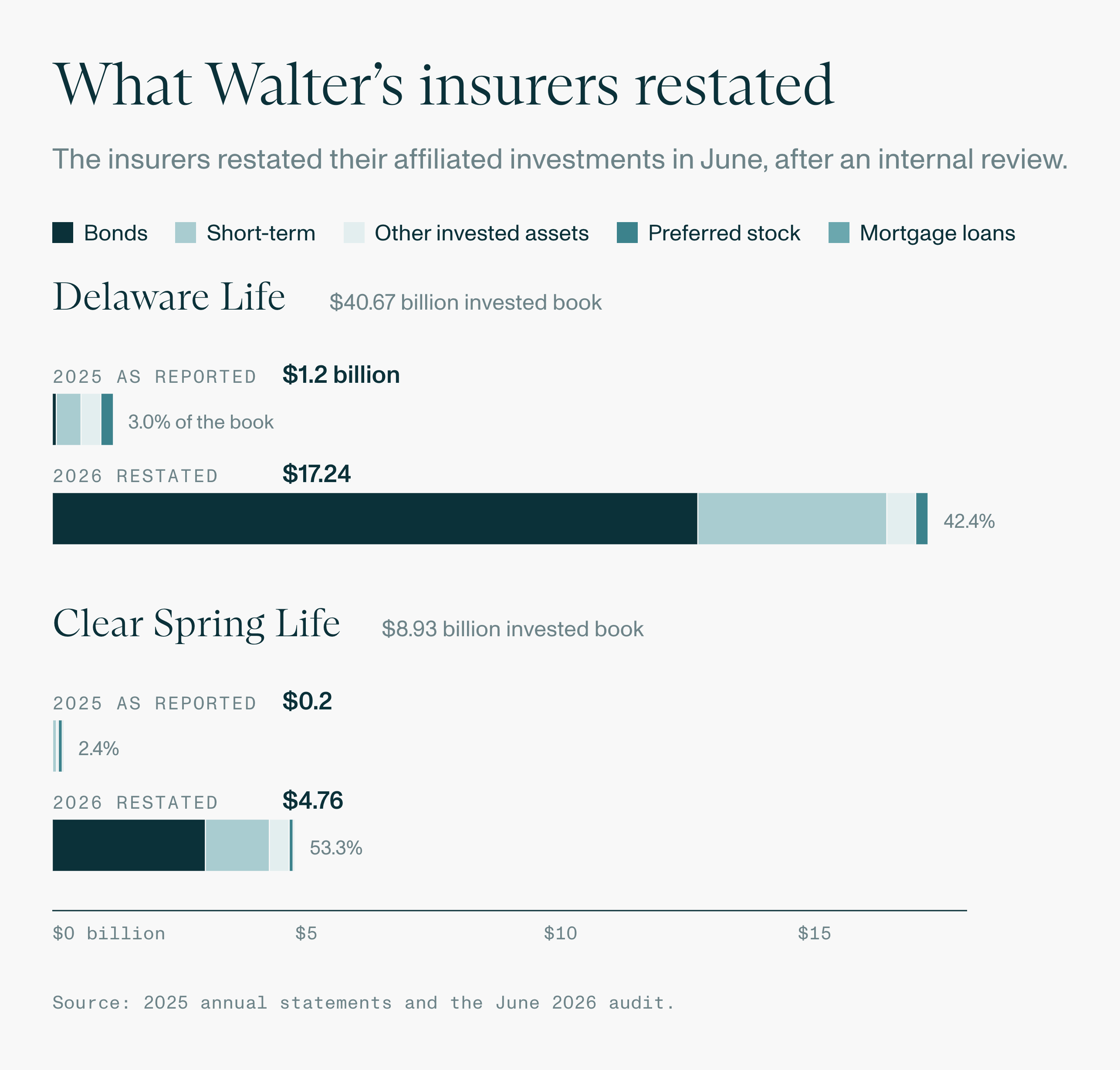
Some of those deals were structured through layers of entities tied to Walter or his holding company. Insurers must disclose affiliated investments to regulators mainly to protect the assets needed to pay policyholders.
Last week, two banks paused distribution of products tied to Delaware Life. TWG said it was working to resolve regulatory concerns and that there has been no fraud.
The gaps in Walter’s ownership disclosures
In its June corrective filing, Delaware Life’s ownership chart listed 365 companies under Walter, stacked as deep as 12 layers. The insurer had originally said in 2024 that Walter owned only about a third of those.
The names change from deal to deal, but the setup is often the same: Walter’s insurers put money into newly formed companies through firms that manage or arrange the investments.
Walter’s insurers did not always report those relationships consistently, a Middesk analysis found. Delaware Life named Private Debt Investors Feeder as an affiliate in 2024 but it failed to do the same for $412 million of bonds issued by one of the firm’s subsidiaries. Only this summer did the insurer put the bond issuer beneath the Feeder in Walter’s ownership chart.
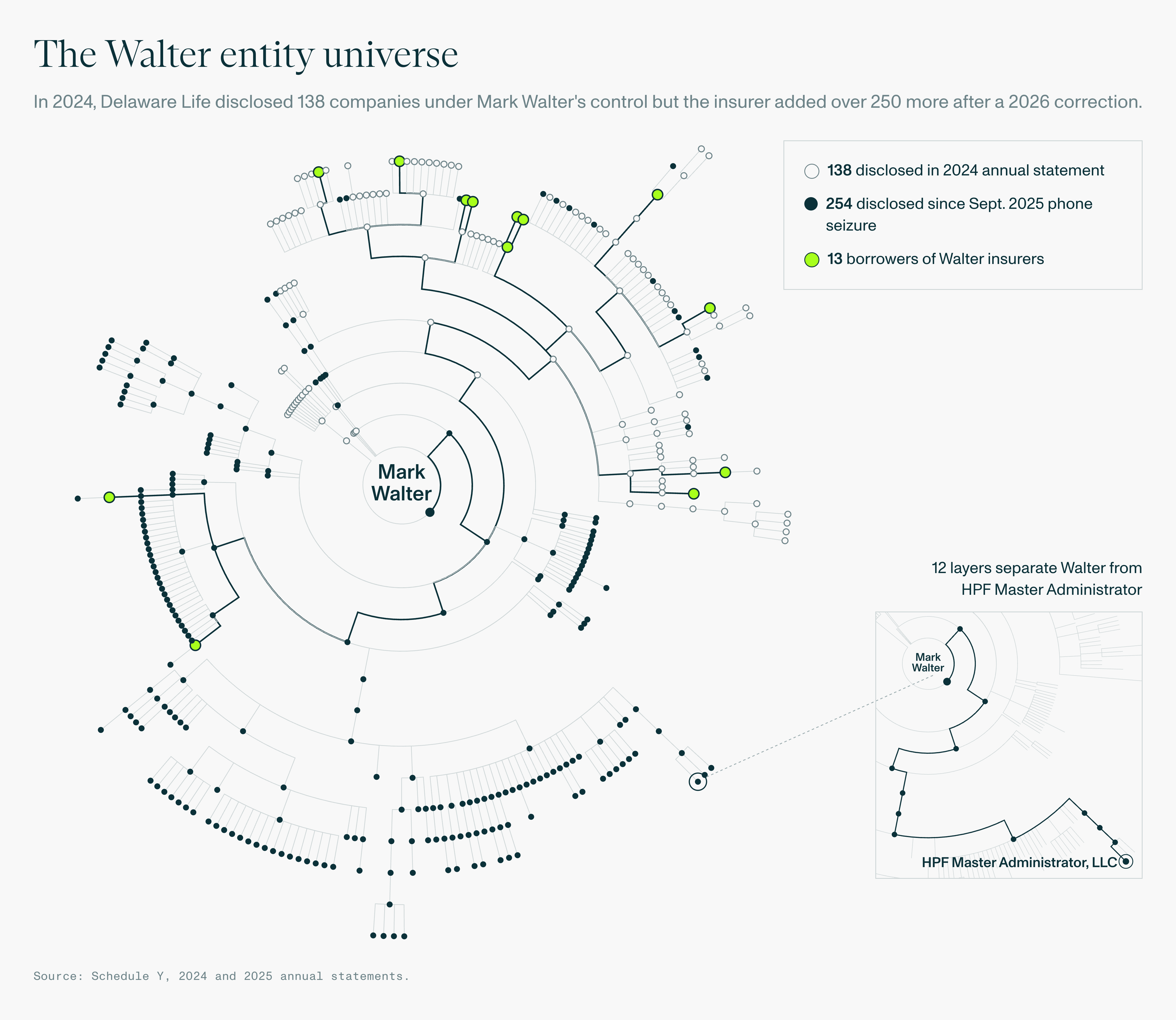
That inconsistency is present across the insurers’ broader portfolios and those of the two other firms that Guggenheim Partners acquired between 2009 and 2011: EquiTrust Life and Security Benefit. Matching ownership charts against bond schedules and UCC filings, which record a lender’s claim on a borrower’s assets, revealed a financing system that moved billions of dollars through purpose-built entities for more than a decade.
Companies the insurers identified as affiliates tended to share three traits: they used an insurer’s or arranger’s address, had invented financial names and were often only weeks old when the insurers filed liens against them.
Middesk searched the insurers’ remaining 3,500 borrowers for the same pattern and found 9% had it. Most were reported as unaffiliated, although other records tied 135 of them to the wider insurer group.
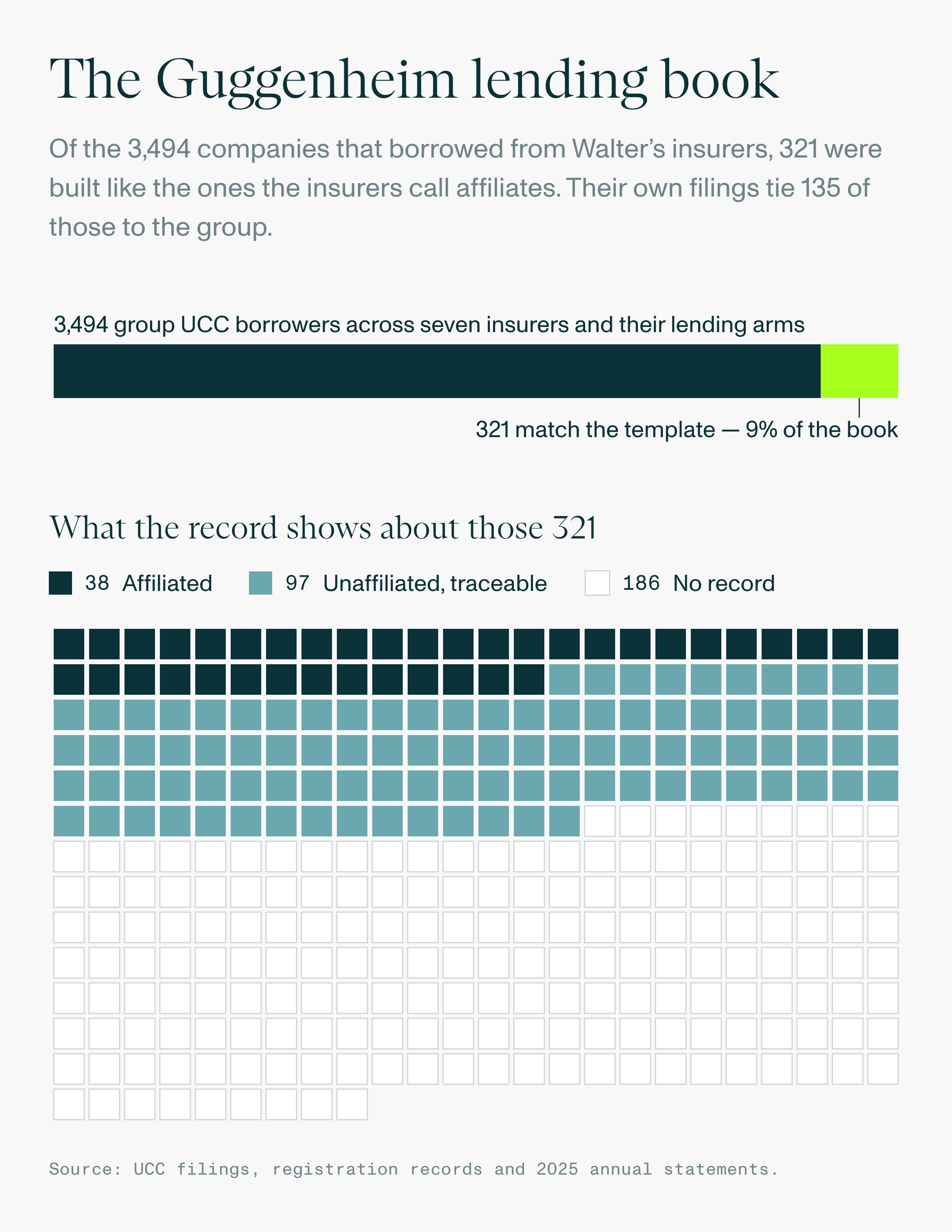
About 5% of Delaware businesses with liens were both newly formed and abstractly named. Walter’s insurers financed companies matching those traits 18.6% of the time, at least twice the rate of the three other insurers analyzed.
How the network helped finance Bumble
In late 2025, Delaware Life’s third-largest holding in any single issuer was $438 million of bonds from a company we’ll call the CLO. The insurer reported the money as lent to an outside firm. In June, its ownership chart placed the CLO under a company Walter controls.
In April, Bumble needed to refinance a loan and it borrowed $475 million from 28 lenders. Almost half of them were vehicles managed by Walter’s Guggenheim and together they put up about $262 million. Among those 13 Guggenheim-managed companies, there was the CLO and a company we’ll call Bridge.
Bridge put up $73.5 million, the largest commitment of the thirteen. On paper it signed the loan the same way the CLO did, with Guggenheim as its manager.
Bridge was registered in Delaware on one day alongside three siblings with almost the same name. One of those siblings borrowed money with Delaware Life acting as the lenders’ agent. So did the CLO’s own sister companies. None of the other nine Guggenheim vehicles on the Bumble loan has ever borrowed from the insurer that way. EquiTrust, the former Guggenheim-network insurer, has also committed $250 million to that Bridge sibling.
Four offices at the center of the transactions
Prosecutors have narrowed in on four firms: ABS Capital, Bradford Allen, Hudson Trading and Amistad Financial, according to The Wall Street Journal. Delaware Life and Clear Spring filings list investments of $1.27 billion in companies carrying the four firms’ names, and the insurers reported all of them as unaffiliated.
The transactions involving those firms stand out for how quickly liens followed registration. Across the roughly 3,500 businesses that have borrowed from Walter’s insurers, the typical one had been in existence a little over three years when the first lien was filed against it. At Bradford Allen’s address the gap is 23 days. At Hudson Trading’s, it’s under two weeks.
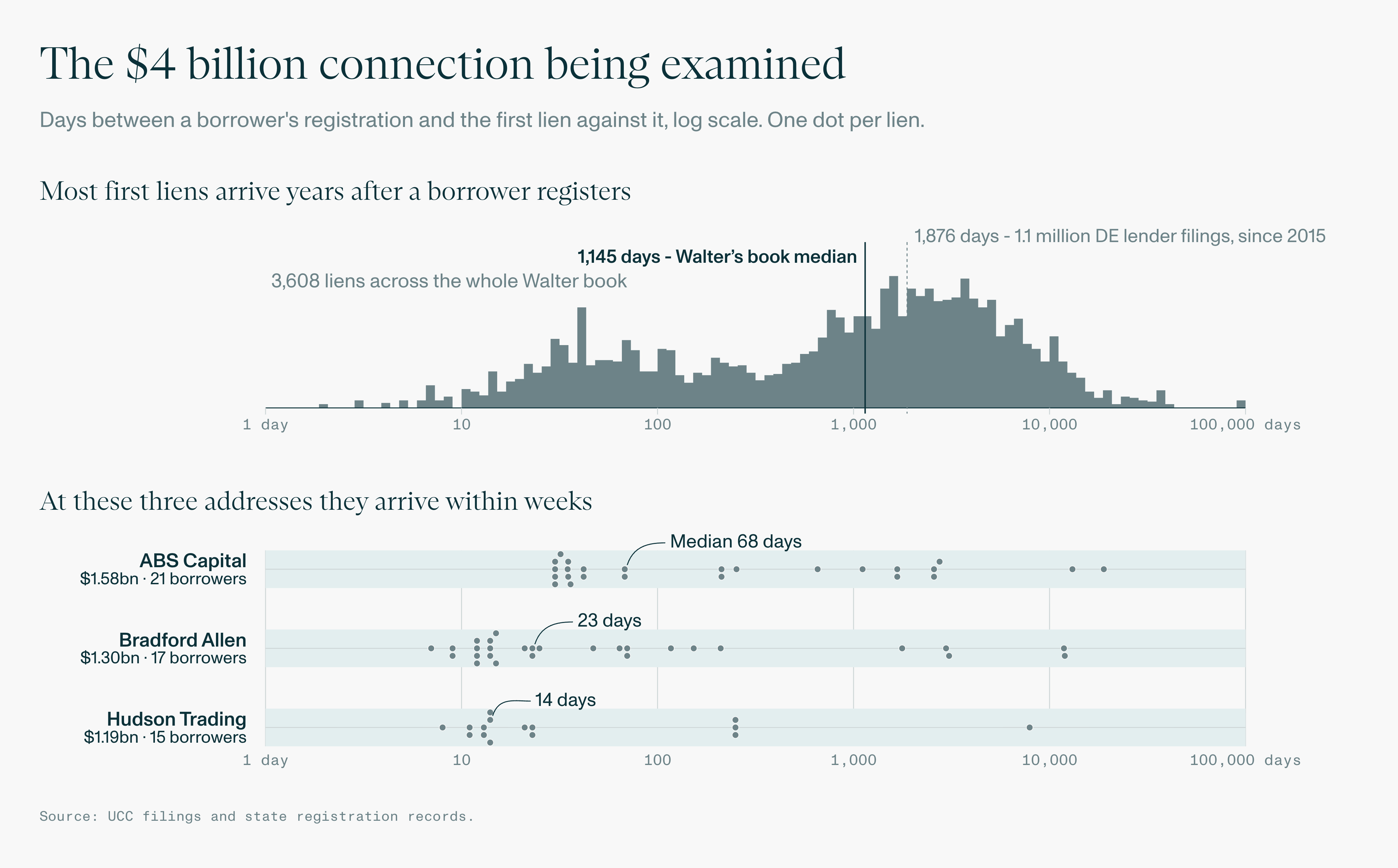
Some 26 companies borrowing from Walter’s insurers used Bradford Allen’s address as their own. They’re all named after Chicago streets. In late 2025, Walter’s two insurers held $1.30 billion of their debt, all of it reported as money lent to unaffiliated companies.
More than 15 companies borrowing $1.19 billion from Walter’s insurers used Hudson Trading’s office in their lien filings. In one case, three of the borrowers were registered on the same day and Clear Spring recorded lending them money within 11 days. Another 25 companies that borrowed $1.58 billion from Walter’s insurers listed ABS Capital’s Miami office as their own. ABS was founded by two former Guggenheim executives.
In 2023, Delaware Life filed a lien against a company called Amistad Debt Warehouse 1, registered 15 days earlier, and recorded buying $69.4 million of its notes the same day. Clear Spring bought $43.4 million of the same notes that day. Both insurers reported the purchase as unaffiliated. Amistad Financial is one of the four firms prosecutors are examining.
In January, just before the insurers were subpoenaed, six companies were registered using tree names: Cherry Wood, Elm, Pine, Birch, Walnut and Willow Avenue Capital. They all had Bradford Allen’s address. Delaware Life bought $380 million of their notes in five days and reported all six as affiliated in its 2026 quarterly filings.
The insurers filed liens against 27 batches of three or more Delaware companies registered on the same day. Each company had a financial name and one of the carriers filed a lien on it within 90 days.
A decade-old pattern
In February 2014, two policyholders filed a proposed class action against Guggenheim Partners, Security Benefit Life, Guggenheim Life (now Clear Spring) and EquiTrust Life. They alleged that the insurers had invested $914 million in nine newly formed Delaware companies while reporting the investments as unaffiliated. The complaint said that more than $1.2 billion in insurer money helped finance the Dodgers purchase.
The plaintiffs voluntarily dismissed the lawsuit the next day. Delaware corporate records confirm a narrower set of facts: the nine companies existed, were registered in two same-day batches through the same commercial filing agent, and six later used Guggenheim’s Chicago headquarters as their mailing address.
The complaint raised concerns about the same mechanics now visible in the insurers’ filings: newly formed companies, insurer money moving through them and affiliation labels that changed or conflicted across records.