


Nvidia CEO Jensen Huang, his numerous reported love affairs and his departure from the company took the world by storm last week.
The thing is, though, that Megaspeed—whose CEO is an alleged spy working for China who had an affair with Huang—has been under investigation by multiple agencies for allegedly being a multi-billion-dollar clearinghouse to funnel banned, cutting-edge AI chips to China.
How, you ask? Nvidia chip smugglers have been evading customs controls since at least 2022.
Please follow me…
The circumvention playbook
Since last year, the Justice Department has charged defendants in six investigations into smuggling, or attempts to smuggle, Nvidia chips to China. Four defendants and one company have pleaded guilty. The other cases are ongoing.
Here’s how law enforcement said they did it:
ALX Solutions claimed fake end users in Singapore and Japan, removed “assembled in USA” labels and shipped equipment through Malaysian and Singaporean forwarders.
Janford Realtor was used as a front to buy GPUs and ship them through Malaysia and Thailand. About $4 million wired from China paid for 400 A100 chips.
Operation Gatekeeper caught smugglers declaring GPU boards as “computer servers” and swapping Nvidia labels for those of a brand they made up.
A Super Micro co-founder sold servers through a Southeast Asian front buyer, repacked them in unmarked boxes and used a hair dryer to move serial-number stickers from real servers onto dummies staged for audits.
Three men in Atlanta allegedly posed as buyers for Thai companies with false end-user certifications, but the server maker blocked both orders.
Earthmade Computer submitted false end-user and destination papers, routed servers through Malaysia and Singapore, and staged dummy servers for inspectors.
No one asked me, but these look like similar operations exploiting a number of loopholes. If you read the list again, the same countries come up quite a bit.
On Monday, the Commerce Department issued a rule restricting shipments of chips going to Malaysia, Thailand, Indonesia, Singapore and Brazil. A license may be required if an exporter knows a data center will give a Chinese company access to computing power, even if the chips never enter China.
Megaspeed’s footprint sits right on these routes. The company’s 2024 records list subsidiaries in Malaysia, Thailand and Indonesia, three of the hubs that keep showing up in the cases. The Wall Street Journal has reported nearly $12 billion of China-directed arrangements involving the company between March 2024 and June 2025. Megaspeed denies wrongdoing and hasn’t been charged.
Today, The New York Times reported that the Commerce Department said Nvidia had put Megaspeed in a ‘no-sell’ list in June 2025.
I pulled the shipping records for Speedmatrix, Megaspeed’s Malaysian data-center arm. Between November 2025 and February 2026, it brought in about $924 million of goods across 266 shipments. Most of that, $822 million, came from Aivres, a server maker tied to China’s Inspur. The rest came from Chinese computing, optical and networking suppliers, plus one $13.8 million shipment from Nvidia.
A quick detour into the world of kitchen cabinets
You must feel confused at this point but I promise it makes sense.
Two years ago, I reported on a similar, but reversed, situation taking place in the kitchen cabinet industry. A Chinese producer was making the cabinets and parking them in Malaysia, where the “made in” label would get swapped before the cabinets were shipped into the U.S., successfully evading customs duties and tariffs.
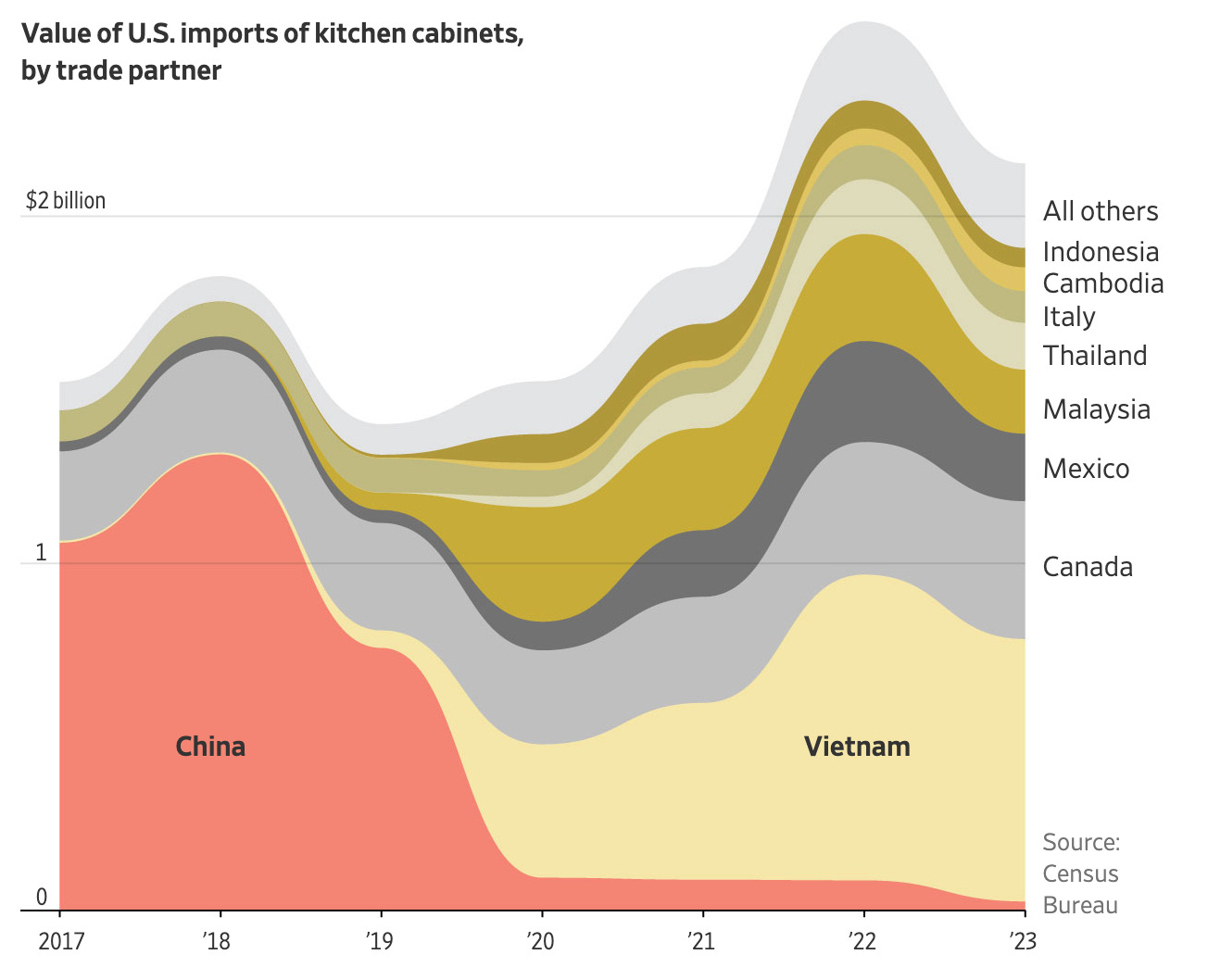
Why did I look at kitchen cabinets? I was working with trade data and saw a dramatic drop in the value of kitchen cabinets coming from China. What had been a billion-dollar-a-year industry plummeted to $25 million. The data showed that billions in cabinets were still coming into the U.S., but now it was from countries like Vietnam or Malaysia. Turns out it was all made in China.
Now let’s look at chip and server trade data
The smuggling investigations describe the same basic route: servers are sold to a buyer in Southeast Asia that looks legitimate, pass through a hub such as Thailand, Malaysia or Singapore, and then go on to China.
If that’s happening at scale, it should leave marks in the trade data. It does, though the data can’t tell you whose servers they were.
Nvidia’s chips are made by TSMC in Taiwan, and the servers they go into are mostly built by Taiwanese companies such as Foxconn, Quanta and Wistron. Taiwan’s government says Taiwanese companies build about 90% of the world’s AI servers.
So for anyone trying to divert Nvidia hardware, Taiwan is another important starting point. The U.S. restriction on Nvidia chips covered those manufactured in Taiwan.
Data for shipments of servers coming from Taiwan suggest that the products were just making a quick stop in Thailand before being shipped to China.
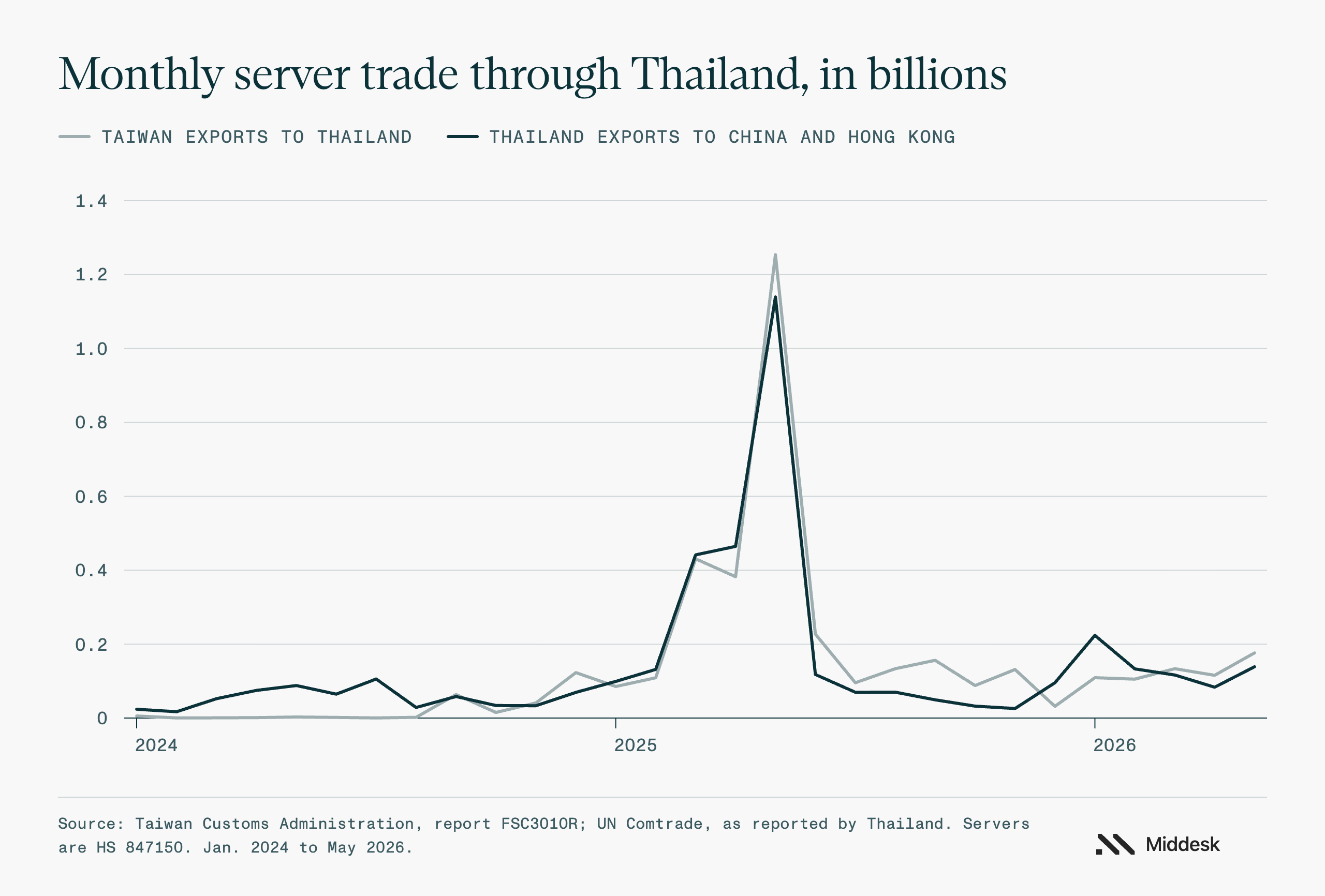
Customs records from China report the country of origin of the item, rather than where it was shipped from.
This is what the chart looks like when we overlay the lines coming from Chinese customs data:
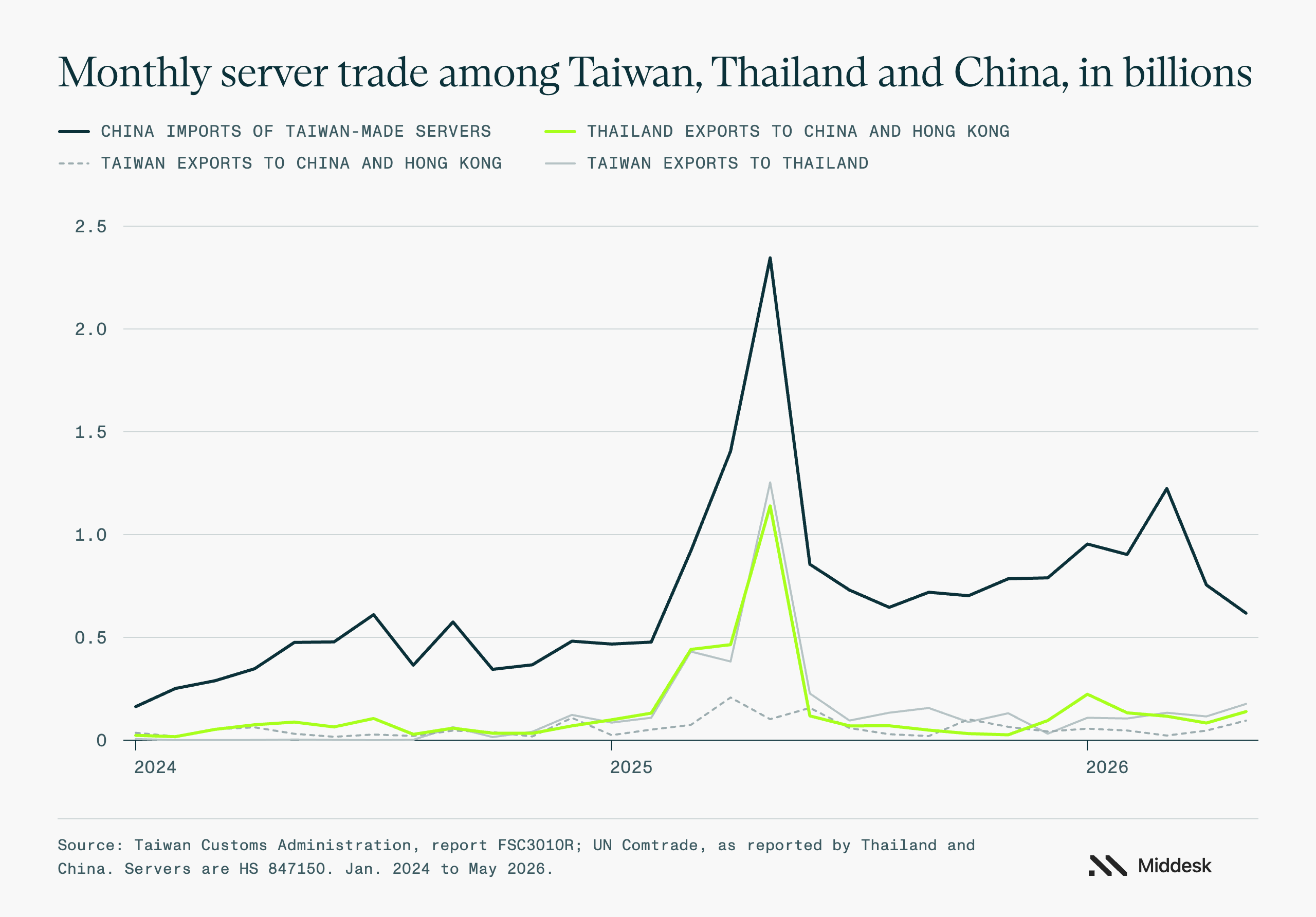
If we focus on that early 2025 spike, you can see that Taiwan says it barely sent any of its chips and servers to China but China says more than $2 billion worth of chips manufactured in Taiwan arrived in China.
Now here’s what the Chinese government data looks like:
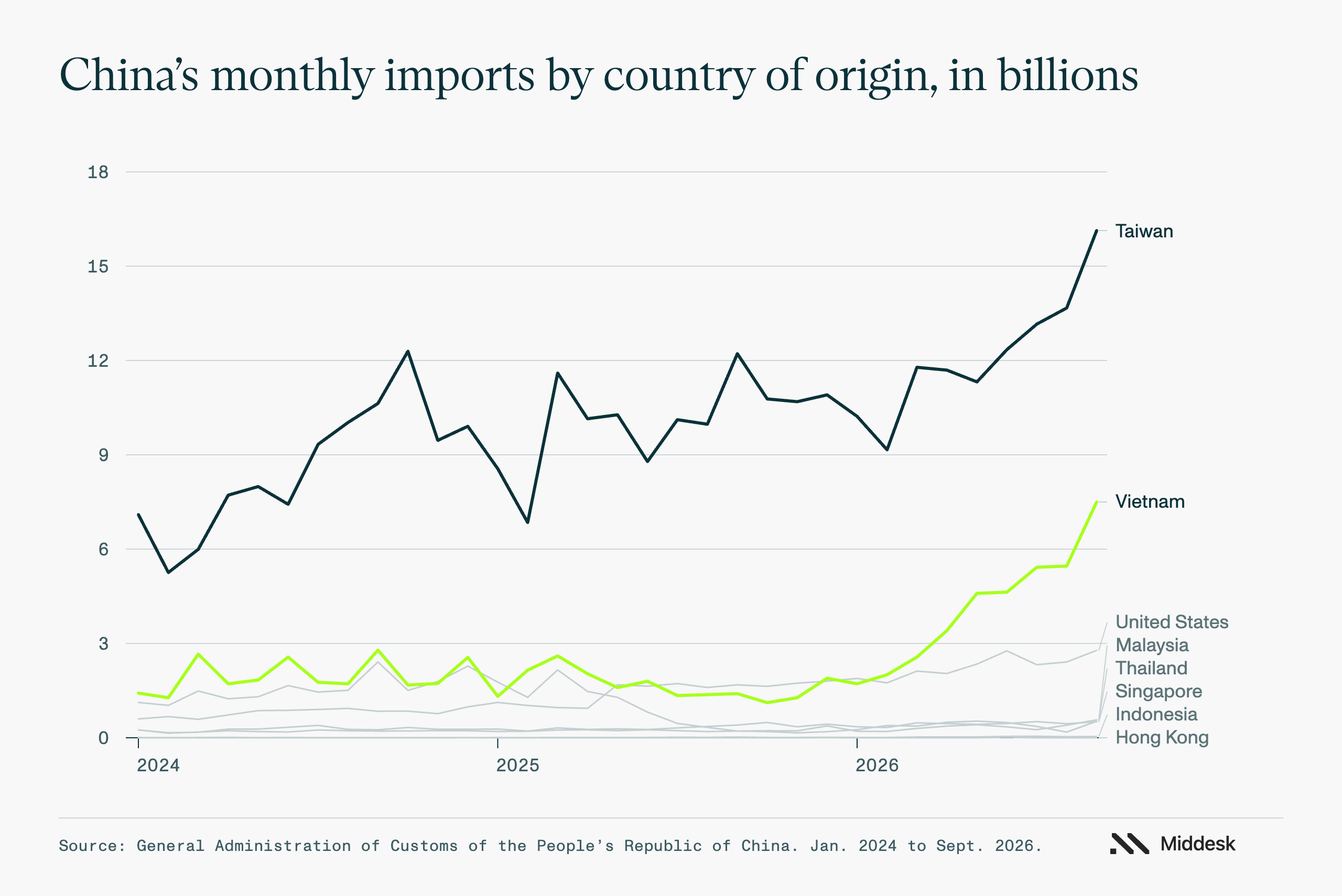
It would seem like Vietnam is becoming a huge player in AI chip and server manufacturing.
Vietnam’s National Statistics Office reported that the country’s exports of computers, electronics and parts to China doubled in a single month, from $2.9 billion in August to $6.0 billion in September. China’s customs data shows a similar jump from the other side. Vietnam’s imports of these goods from Taiwan reached about $4.5 billion a month in 2026.
That pattern is consistent with Vietnam possibly serving as a stop between Taiwan and China. Goods arrive from Taiwan, while the value of shipments leaving for China rises in the same months. China’s data shows the value per kilogram of the parts coming from Vietnam rose about tenfold, to levels consistent with GPU boards. It also reported most of those imports entered China through bonded and special customs zones, which handle goods in transit.
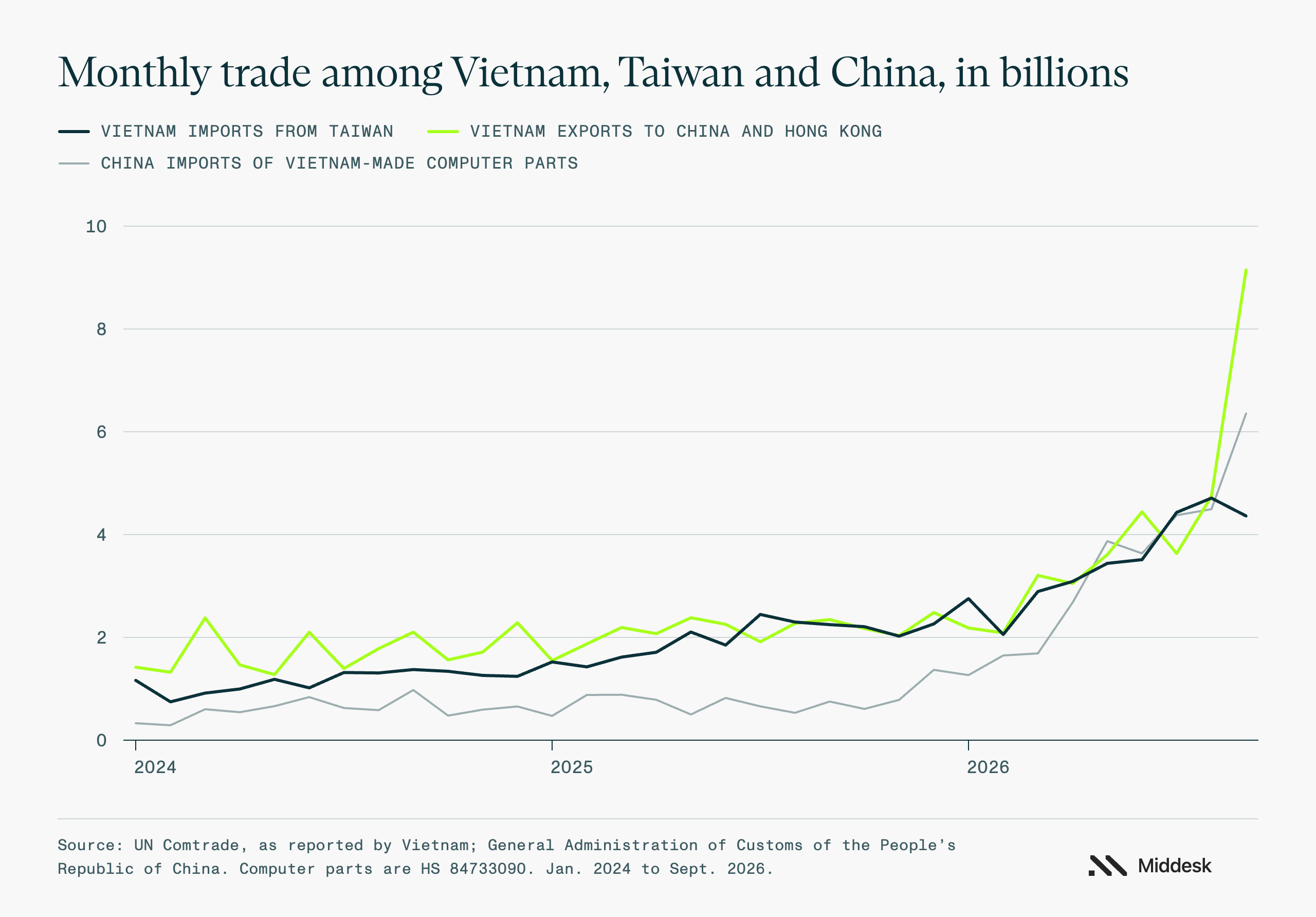
There is also an alternative explanation for Vietnam’s surge: Foxconn and Etron have expanded server production in Vietnam. Taiwan’s Market Intelligence & Consulting Institute said Vietnamese plants mainly assemble compute trays, the GPU boards that go inside AI servers. A growing assembly industry would also bring in components from Taiwan and ship finished boards to China. Vietnam reports these goods as one broad category that includes phone parts and other electronics, so its figures can’t show how much was servers or GPUs.
This isn’t proof that every shipment involved transshipment or circumvention, but the pattern is consistent with the schemes described in the investigations.
Let me tie it all together before I let you go: this is exactly what the kitchen cabinet shipments looked like.
The case of El Monte
I will leave this for part two, where I’ll look at two of the smuggling operations that have been investigated by authorities. Stay tuned!
Here’s a warehouse in California where one of the operations was taking place.

Super interesting!