


Welcome! This is the beginning of a new space where Middesk will explain current events and developments that speak to the evolution of businesses, fraud and the economy.
My name is Inti Pacheco and I’ll be your guide (most times). I’m a data journalist who worked for about a decade at The Wall Street Journal, writing about those topics.
We’re also here to collaborate and hear from our industry peers, customers, experts… and from you. Tell us what you think we should dig into 👀.
… back to FinCEN
For a usually slow-moving agency, FinCEN has been on a tear during the first half of 2026.
Two years ago, FinCEN was mostly executing a Congressional to-do list, rolling out beneficial ownership reporting and extending anti-money laundering (AML) rules to new sectors. Now it has reversed course, delaying the investment adviser AML rule, gutting beneficial ownership reporting, and swapping process-driven compliance for an outcomes-based model.
Financial institutions and other organizations aren’t complaining. Or at least not a ton.
In June, FinCEN said fraud information can now be shared under the 314(b) safe harbor, which protects financial institutions from liability when they share information about suspicious activity. That includes transaction data, IP addresses, and device identifiers, among others.
The update dropped after the agency received 112 comments on its April rule proposal to reform programs fighting illicit finance. The agency said in its proposal that programs would be judged on effectiveness over process.
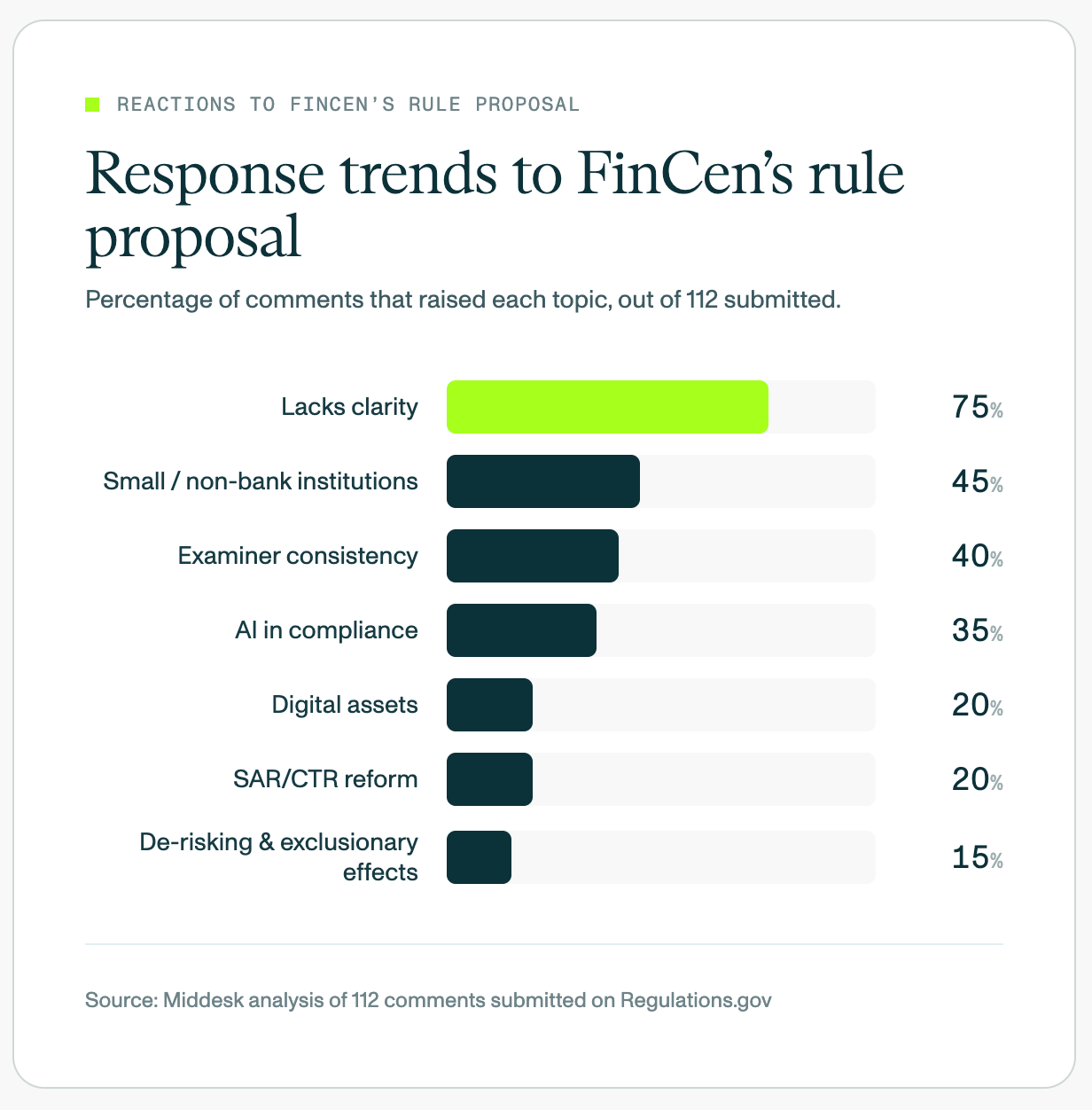
Overall, folks supported the direction of the rule but said it lacked clarity. Some basically said it was kind of pointless because of how vague some terms were.
“A bank can satisfy every element of the proposed definition and still run a program that fails to produce useful results.“ — iKinetiq Innovation Solutions president Stuart Brock.
We parsed the 112 comments about the proposal submitted on Regulations.gov by financial institutions of all sizes (and their big associations).
Here’s what they talked about:
Sharing more on fraud
Financial institutions have been enabled to share more information now that fraud offenses qualify as specified unlawful activities, the legal threshold to trigger the safe harbor.
Will it solve fraud? No. Are financial institutions satisfied? Not fully. But compliance experts and organizations who have been calling on this for years said it’s a step in the right direction.
The guidance for the Section 314(b) safe harbor requirements hadn’t been updated since 2020. Industry groups had long pushed FinCEN to explicitly cover fraud in the safe harbor, and Congress had broadly called for AML modernization.
It will make things easier for participants to fight fraud. It’ll definitely help the big fraud information-sharing networks owned by Nasdaq and a consortium that includes JPMorgan Chase. Banks and other financial institutions will have an easier time protecting themselves and each other.
The Bank Policy Institute said the update was a “critical step in helping banks to disrupt fraud and scams in real-time.” BPI also said it encouraged Congress and other agencies to remove legal uncertainty and establish clear safe harbor for banks.
As of late 2020, there were over 7,000 organizations participating in FinCEN’s 314(b) program. There’s likely many more now but the agency stopped updating the number.
How was information shared before?
The big banks have had their own thing for a while.
JPMorgan Chase, Wells Fargo, and others, own a data consortium called Early Warning Services. It counts 5,000 banks, credit unions, payment companies, merchants and government agencies as members. It said it screened $11 trillion in payments and stopped $3.7 billion in potential fraud.
Some 2,800 organizations use Nasdaq’s FRAMLxchange, which lets them share data on suspicious activities under the 314(b) safe harbor.
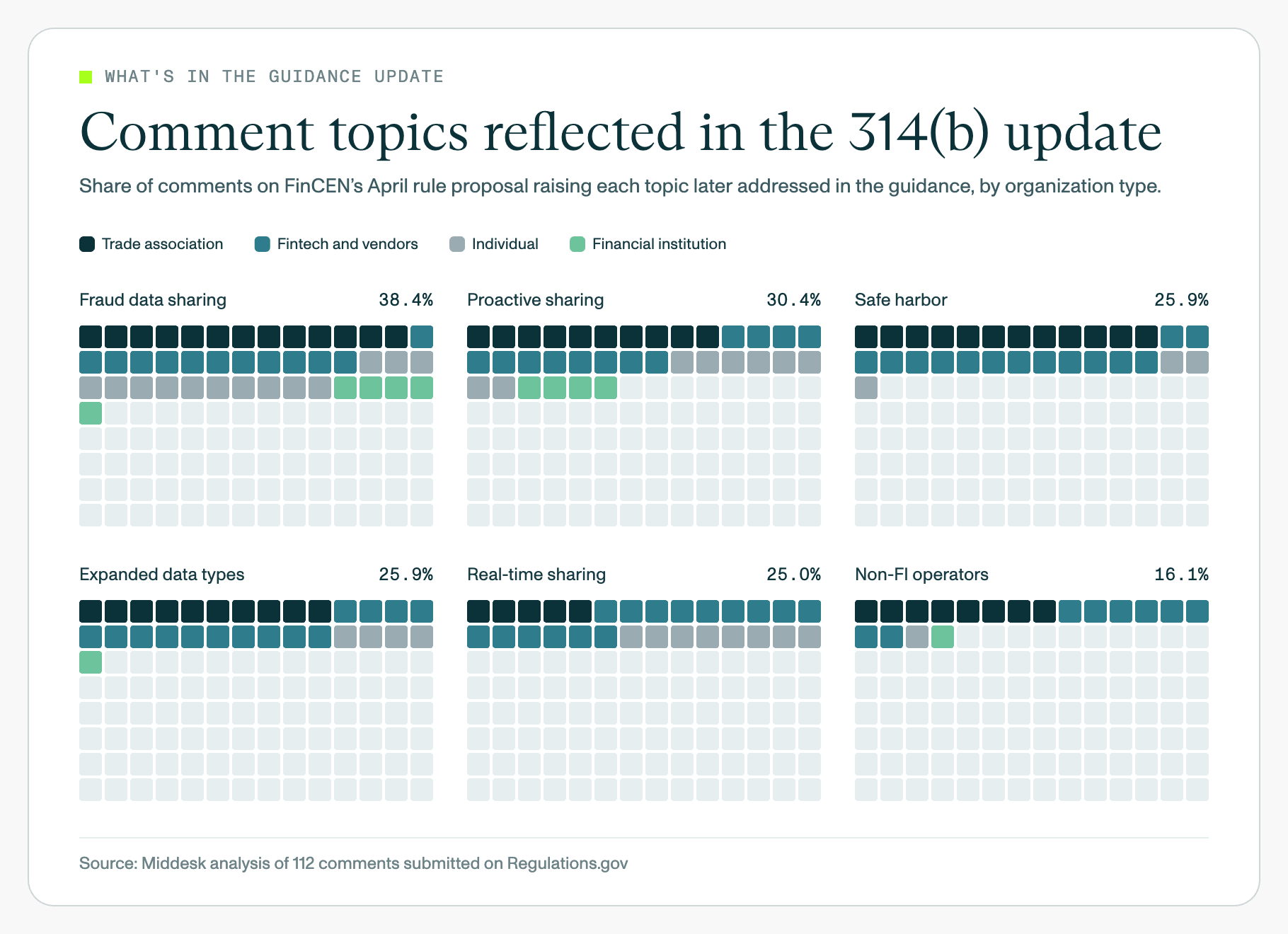
Both Nasdaq and BPI/Clearing House, the trade group representing EWS’s bank owners, said in their comments that FinCEN’s rule proposal didn’t address the sharing mechanics to handle cross-institutional collaboration. A lot of what the new guidance says about information sharing was in the proposal comments.
Here’s how many of the comments submitted by trade associations, fintech companies and other financial institutions addressed topics that ended up in the 314(b) guidance:
How will things change?
Fraud teams hesitated to use 314(b) when fraud did not map cleanly to money laundering. The guidance will let them move fast and cross-institutionally, just like the fraudsters do.
A suspicion of fraud alone is now sufficient to trigger information sharing. Banks do not need to identify specific proceeds of fraud being laundered. Bank A can alert Bank B about the invoice scam the moment they suspect it, without needing to prove a money laundering connection first.
Neither EWS nor Nasdaq said much about the guidance but the update will work as a tailwind for both. Criminals often spread activities across institutions and these networks alert investigators about risky entities. These systems let investigators share notes and data to collaborate privately.
Assuming they share more information, businesses can benefit from faster resolution if their accounts get wrongly flagged. The catch is that fraud detection already generates false positives and faster signal sharing could make the problem spread across institutions.
This move means FinCEN is now trying to get the broader market to do what the big banks already set up for themselves outside the program.
The Middesk Brief decodes complexity for business owners and the institutions that serve them.
Tell us what we should look at in the comments: