


Domestic companies will no longer have to report who owns or controls them to the Financial Crimes Enforcement Network. The data collected from U.S. businesses in about 15 million reports submitted between January 2024 and March 2025 will be thrown away.
FinCEN’s decision to finalize its beneficial ownership information reporting rule under the Corporate Transparency Act is the latest turn in a tussle that began in 2021, when Congress decided to give investigators a standardized record of who owns and controls U.S. companies.
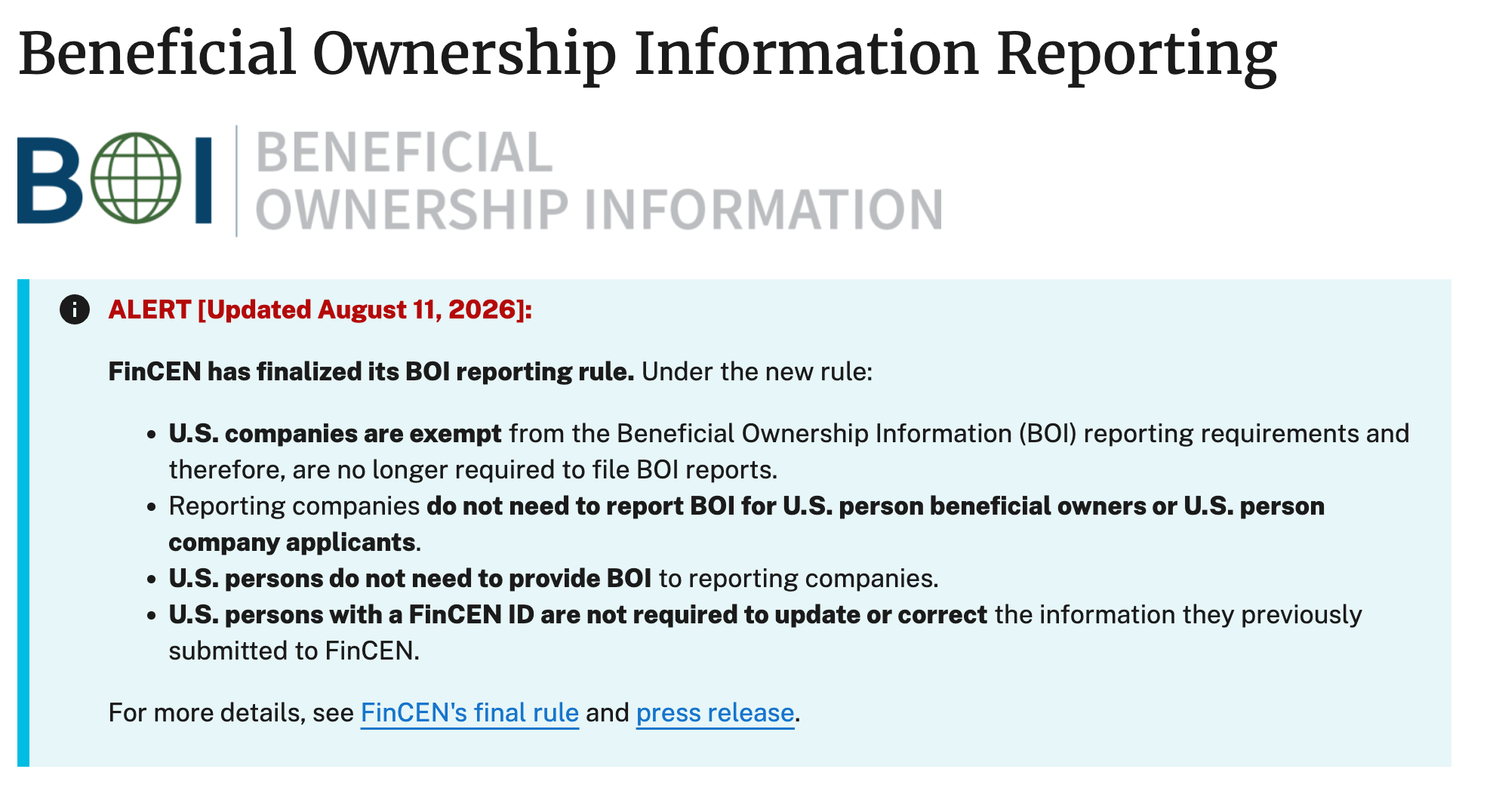
The Trump administration halted enforcement against U.S. companies in March 2025, and FinCEN exempted them from future reporting. The rule makes the exemption permanent for U.S. companies, but foreign entities registered in the U.S. still have reporting obligations.
Treasury Secretary Scott Bessent described the rule as “a victory for common sense and American small businesses.” Bessent said the update removed a burdensome requirement without compromising national security. Small-business groups supported the rollback but said the CTA remained a challenge and called it a massive burden on job creators that won’t stop money laundering.
“FinCEN has significantly hindered prosecutors’ ability to identify the bad actors from legitimate businesses,” said National District Attorneys Association executive director Nelson Bunn.
FinCEN initially estimated there would be 32.6 million reporting companies in 2024. It said the rule update removes reporting obligations for roughly 27.5 million companies that had not yet filed or were expected to file in 2025 and 2026. The change cuts the annual reporting burden by some 53 million hours and avoids about $18 billion in modeled compliance costs, FinCEN said.
Banks still face customer-due-diligence requirements
Due diligence is still very much part of the job for banks and compliance teams, and the burden of identifying the people behind a business is now more on them. The Bank Policy Institute, which represents the largest U.S. banks, said as much when the exemption was first announced last year. The trade group asked FinCEN to reduce unnecessary reporting but to preserve useful data for banks and law enforcement.
Financial institutions can still collect ownership information directly from customers, but that creates friction and delays. Compliance teams will no longer be able to use federal files on domestic companies to compare what they get, and state filings are not standardized. Some identify officers, directors, managers, or members without establishing ownership or control.
Under the system Congress created, a company would file an initial ownership report with FinCEN and update it when its ownership or control changed. Authorized law-enforcement agencies and financial institutions with customer consent could obtain information from that federal registry through restricted channels.
Treasury’s 2026 National Money Laundering Risk Assessment said shell companies can disguise illicit transfers as ordinary business activity and obscure the people behind them. The report said a Chinese money-laundering network moved more than $92 million through shell-company accounts at U.S. banks.
GAO found gaps in state and bank ownership records
In May, the Government Accountability Office said that the exemption at the time applied to more than 99% of the companies that had been expected to file ownership reports with FinCEN. Most were U.S.-formed companies, which were exempted from reporting altogether; the rule also removed U.S. persons from reports filed by foreign companies.
GAO then checked whether banks, state offices, and investigators could still identify the owners of those companies. Banks collect ownership information from their own customers, but not every company has an account covered by federal banking rules. Its review found that state records are not consistent in what they collect, how often companies update them, or who can access them.
Investigators can use subpoenas, suspicious-activity reports, and comme
rcial databases, but those sources do not create one complete record of company ownership. Those details mattered because shell companies can make it hard to identify the people behind money from drug trafficking, fraud, and other crimes.
GAO said Treasury had not shown it could replace the information the federal system would no longer collect and said it should make a plan. The Treasury disagreed.
Challenging the Corporate Transparency Act
The permanent exemption followed legal challenges from a Texas police-supply and uniform business, a Wyoming dairy, and the National Federation of Independent Business. The businesses argued that Congress could not require small, largely local companies to send their owners’ personal information to FinCEN. Small-business groups also backed repeal bills, coalition letters, and advertising campaigns.
One case reached the Supreme Court after a federal judge blocked the CTA nationwide. The Supreme Court lifted the block so the litigation could continue, but it did not decide whether the law was constitutional. The Eleventh Circuit later upheld the CTA in a separate case. As of Friday, the Supreme Court had not decided whether to hear further challenges.
Congress has considered repeal as well. In April, the House Financial Services Committee advanced the Repealing Big Brother Overreach Act. The bill reached the House calendar in June but has not been enacted.